

When is Cystectomy Needed?
Cystectomy in Bengaluru may be recommended for:
for:
- Muscle-invasive bladder cancer — tumors that have grown into the bladder wall muscle
- High-risk non-muscle-invasive bladder cancer — recurrent or aggressive tumors that have not responded to less invasive treatment (such as TURBT or intravesical therapy)
- Severe chronic conditions — such as radiation cystitis or interstitial cystitis, in rare cases where the bladder is no longer functional
- Congenital bladder abnormalities requiring reconstruction
Symptoms that May Warrant Evaluation
A bladder condition serious enough to require cystectomy usually presents with:
- Blood in the urine (visible or detected on testing)
- Persistent pelvic pain
- Frequent or urgent urination that doesn’t resolve with standard treatment
- Painful urination unrelated to infection
- Unexplained weight loss (in cases involving malignancy)
These symptoms warrant a proper urological workup, not a presumption of cystectomy. Most bladder symptoms have less invasive causes.
Diagnosis
Before recommending cystectomy, a full diagnostic workup is done:
- Cystoscopy — direct visual examination of the bladder lining
- CT urogram or MRI — to assess tumor size, depth, and spread
- Urine cytology — to check for cancerous cells
- Biopsy (via TURBT) — to confirm diagnosis and tumor grade/stage
- Metastatic workup — CT chest/abdomen/pelvis or bone scan if invasive cancer is confirmed
Types of Cystectomy
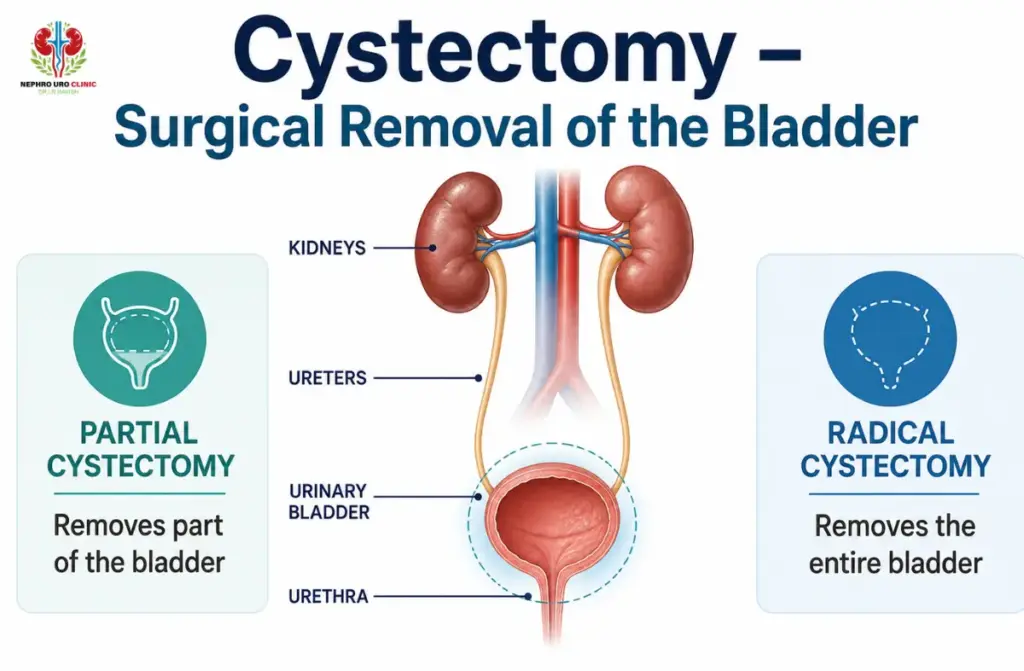
Partial cystectomy Removal of the affected portion of the bladder, used only in select, localized cases where the tumor is isolated and the rest of the bladder is healthy.
Radical cystectomy Complete removal of the bladder, along with nearby lymph nodes and, depending on the case, the prostate (in men) or uterus and ovaries (in women). This is the standard treatment for muscle-invasive bladder cancer.
After radical cystectomy, urine needs a new way to leave the body. This is done through urinary diversion, most commonly:
- Ileal conduit — a segment of intestine is used to create a stoma that drains into an external bag
- Neobladder reconstruction — a new bladder-like reservoir is built from intestine and connected to the urethra, allowing more natural voiding for suitable candidates
The diversion method is decided based on cancer stage, kidney function, patient age, and lifestyle factors, and is discussed in detail with the patient before surgery.
Surgical Approach
Cystectomy can be performed via:
- Open surgery — a single larger incision, used in complex or advanced cases
- Laparoscopic or robot-assisted surgery — smaller incisions, generally associated with less blood loss and a shorter hospital stay, when the case is suitable
The right approach depends on tumor stage, patient anatomy, and overall health, and is determined case by case.
Preparation
Preparation for cystectomy typically includes:
- Pre-surgical staging (imaging and biopsy results reviewed in full)
- Blood tests and cardiac clearance where needed
- Bowel preparation, since intestinal segments are used in urinary diversion
- Stopping blood thinners under medical guidance
- Counseling on stoma care or neobladder function, depending on the diversion planned
- Discussion of anesthesia and expected hospital stay
Risks and Complications
As with any major surgery, cystectomy carries risks, including:
- Infection
- Bleeding requiring transfusion
- Bowel-related complications, since intestine is used in reconstruction
- Blood clots
- Changes in sexual function, depending on nerve-sparing feasibility
- Adjustment period for stoma or neobladder use
An experienced surgical team and close post-operative monitoring reduce these risks significantly.
Recovery
Hospital stay after radical cystectomy is typically 7 to 10 days, longer for open surgery. Full recovery, including adaptation to the urinary diversion, generally takes 6 to 8 weeks. Regular follow-up with imaging and lab work continues for years afterward to monitor for recurrence.
Cystectomy Cost in Bangalore
Cost depends on the surgical approach, type of urinary diversion, hospital stay, and any additional treatment required. As a general range:
- Open radical cystectomy: ₹2,50,000 to ₹4,50,000
- Laparoscopic/robotic cystectomy: ₹3,50,000 to ₹6,00,000
These figures are indicative and vary by case complexity, hospital, and insurance coverage. An exact estimate is only possible after consultation and staging.
Conclusion
Cystectomy is a significant procedure, most often performed for bladder cancer, and outcomes depend heavily on early diagnosis, correct staging, and surgical experience. If you’re experiencing persistent bladder symptoms or have been advised to consider cystectomy in Bengaluru, Dr. I. R. Ravish at Nephro Uro Clinic, Jayanagar, or Sagar Hospitals, Bengaluru, for an evaluation.