
Who Needs Microsurgery for Male Infertility?
Microsurgery is not the first step for every man with fertility problems. It is recommended when a specific physical cause has been identified that surgery can correct or work around.
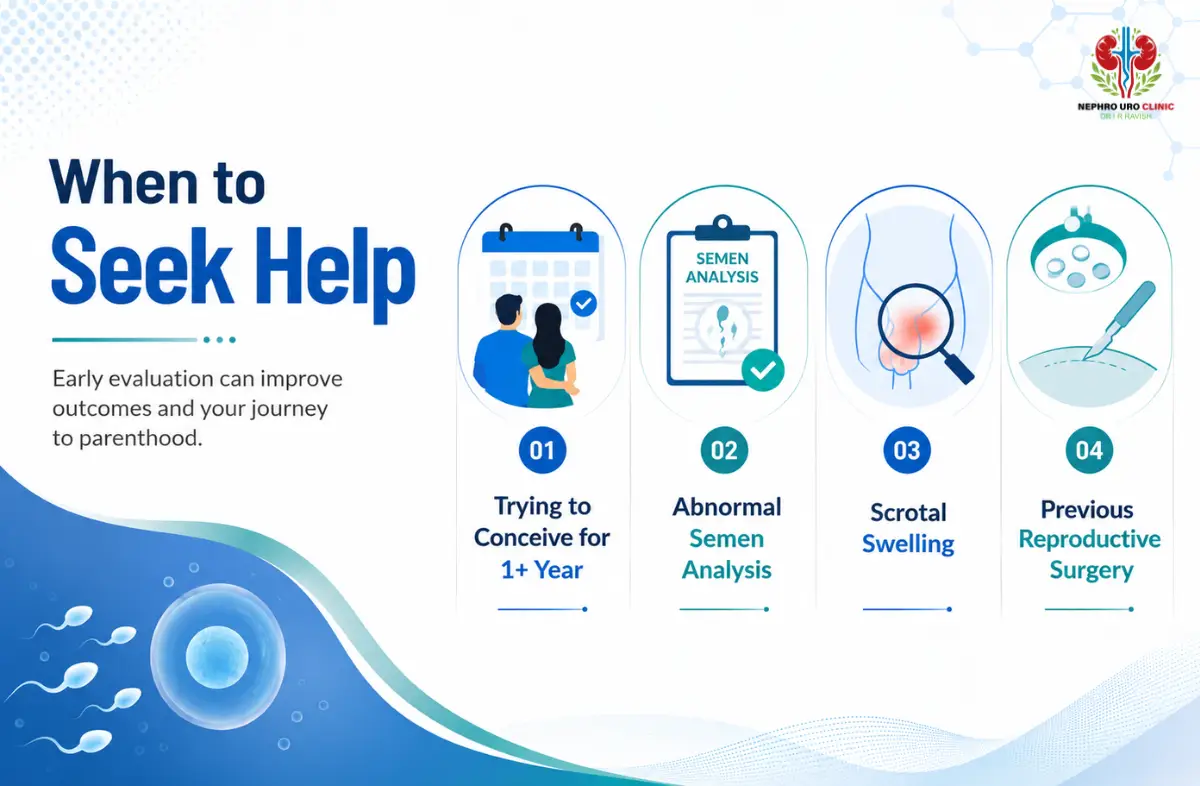
Dr. Ravish evaluates each patient thoroughly before recommending any procedure. A semen analysis, hormone tests, physical examination, and sometimes a scrotal ultrasound are done first. Based on the findings, surgery may be the right path if you have any of the following conditions.
Obstructive Azoospermia Your testes are producing sperm normally, but a blockage somewhere in the reproductive tract is stopping sperm from reaching the semen. This could be in the epididymis, vas deferens, or ejaculatory duct. Surgery can either remove the blockage or retrieve sperm directly from above it.
Non-Obstructive Azoospermia Here, the testes are not producing enough sperm, or in some areas, not producing any at all. This is a more complex situation. However, small pockets of sperm production may still exist deep within the testicular tissue. A procedure called Micro-TESE can find and retrieve sperm from these areas.
Varicocele A varicocele is a group of enlarged veins in the scrotum, similar to varicose veins in the leg. These veins raise the temperature inside the scrotum, which damages sperm over time, reducing count, motility, and shape. Microsurgical varicocelectomy corrects this and often improves sperm quality naturally within 3 to 6 months.
Vasectomy Reversal Men who had a vasectomy in the past and now wish to father a child can undergo a reversal procedure. Depending on how long ago the vasectomy was done and whether a secondary blockage has developed, Dr. Ravish performs either a vasovasostomy or an epididymovasostomy.
Retrograde Ejaculation In this condition, semen travels backward into the bladder instead of exiting through the penis during ejaculation. Sperm retrieval microsurgery allows direct extraction of sperm for use in IVF and ICSI treatment.
Post-Cancer Treatment Infertility Chemotherapy and radiation can severely damage sperm production. For men in this situation, surgical sperm retrieval may be the only way to obtain viable sperm for assisted reproduction.
Ejaculatory Duct Obstruction A blockage at the ejaculatory duct prevents sperm from entering the urethra. Depending on the cause and location, surgery can address this directly.
Procedure
Microsurgery for male infertility involves detailed techniques performed under high magnification. Here is how the process works from start to finish.
- Diagnosis and Planning Before any surgery is scheduled, Dr. Ravish conducts a complete evaluation. This includes semen analysis, blood tests for hormone levels, physical examination, and scrotal ultrasound where needed. The goal is to identify the exact cause and choose the most appropriate procedure for your situation.
- Anesthesia Depending on the procedure, either local or general anaesthesia is used. Simpler procedures like TESA can be done under local anaesthesia. More complex ones like Micro-TESE require general anaesthesia and a longer theatre time.
- Precision Surgery Using a surgical microscope, Dr. Ravish performs the repair, retrieval, or correction with extreme care. The microscope magnifies the operative field up to 25 times, allowing precise work on structures as small as a millimetre. This level of detail is simply not possible with the naked eye.
Recovery
Recovery after microsurgery for male infertility in Bengaluru is generally straightforward, especially compared to open conventional surgery.
Most patients undergoing TESA or MESA are discharged on the same day. Micro-TESE patients may be monitored for a few hours longer before discharge. Here is what to expect in the days and weeks after surgery.
Week 1 Rest at home. Avoid lifting anything heavy. Scrotal support such as snug underwear helps reduce swelling and discomfort. Mild pain and bruising are normal and settle within a few days. Take prescribed medications as directed by Dr. Ravish.
Weeks 2 and 3 Most men return to desk work and light daily activities within 5 to 7 days. Avoid strenuous exercise, cycling, and sexual activity during this period.
Week 4 and beyond Full recovery is typically complete within 4 weeks. Follow-up appointments at Nephro Uro Clinic or Sagar Hospitals in Tilaknagar are important to monitor healing and confirm next steps with your fertility team.
Risks/Benefits
Risks
Like any surgical procedure, microsurgery for male infertility carries some risks. These are generally low when performed by an experienced surgeon.
Possible risks include bleeding, infection, temporary swelling, mild scarring, and in rare cases, damage to surrounding tissue. The microscopic approach significantly reduces these risks compared to conventional open surgery because only the precise target area is operated on.
Benefits
The benefits are substantial for the right candidate.
Higher chances of restoring fertility, minimal tissue damage due to microscopic precision, faster recovery compared to open surgery, same-day discharge for most procedures, and in the case of varicocelectomy, the possibility of natural conception without IVF. For men with non-obstructive azoospermia, Micro-TESE offers a genuine path to biological fatherhood that no other method can provide.
Treatment
Microsurgery offers several treatment options tailored to individual needs:
- Varicocelectomy: Corrects enlarged veins to enhance sperm quality.
- Vasovasostomy: Reverses vasectomy for natural conception.
- Epididymovasostomy: Treats blockages in the epididymis.
When seeking affordable options, understanding the cost of microsurgery for male infertility in Bengaluru can help plan finances effectively. Clinics in Jayanagar and Tilaknagar provide comprehensive consultations to determine the best course of action.
Types of Microsurgical Sperm Retrieval: TESA, MESA, TESE and Micro-TESE Explained
This is the section most men do not fully understand when they first come in. Not all sperm retrieval procedures are the same. Each one is designed for a different diagnosis and retrieves sperm from a different location. Using the wrong technique wastes time and reduces your chances significantly.
Here is a clear breakdown of each procedure Dr. Ravish performs at his clinics in Jayanagar and Tilaknagar.
TESA — Testicular Sperm Aspiration
TESA is the simplest sperm retrieval procedure. A fine needle is inserted directly into the testis and sperm are aspirated out. It takes around 20 to 30 minutes and can be done under local anaesthesia. Patients typically go home the same day.
TESA works well for men with obstructive azoospermia where the testes are producing sperm normally but a blockage is preventing them from appearing in the ejaculate. It is not effective for non-obstructive azoospermia because the sperm production itself is the problem.
MESA — Microsurgical Epididymal Sperm Aspiration
MESA is a step up in complexity. A small incision is made in the scrotum and the epididymis is directly accessed under an operating microscope. Sperm are aspirated from the tubules of the epididymis itself.
This is important to understand: MESA retrieves sperm from the epididymis, not the testis. This makes it the right choice for men with congenital absence of the vas deferens or post-vasectomy obstruction. MESA typically yields a higher number of sperm than TESA, often enough to be cryopreserved for multiple future IVF cycles.
TESE — Testicular Sperm Extraction
TESE involves removing a small biopsy of testicular tissue and examining it for sperm. It is used when needle aspiration has failed, or when the diagnosis suggests sperm may exist in isolated areas of the testis that a needle cannot reliably reach. TESE is performed under general anaesthesia and carries a slightly higher risk of tissue disruption than TESA.
Micro-TESE — Microdissection Testicular Sperm Extraction
Micro-TESE is the most advanced sperm retrieval procedure available. It is the preferred method for men with non-obstructive azoospermia, where other methods have failed or are unlikely to work.
Using a high-powered surgical microscope at 20 to 25 times magnification, Dr. Ravish examines the testicular tissue directly and identifies the specific tubules most likely to contain sperm. Only those tubules are removed. The rest of the testicular tissue is left intact. This targeted approach minimises damage and maximises the chance of finding viable sperm.
Published clinical data reports sperm retrieval rates of 40 to 60 percent for non-obstructive azoospermia using Micro-TESE. This is significantly higher than conventional TESE. Sperm retrieved are used immediately in ICSI or frozen for future use.
Which Procedure Is Right for You?
| Procedure | Best For | Anaesthesia | Duration | Sperm Source |
|---|---|---|---|---|
| TESA | Obstructive Azoospermia | Local | 20–30 mins | Testis via needle |
| MESA | CBAVD, Post-vasectomy block | General | 45–60 mins | Epididymis |
| TESE | Failed TESA, partial NOA | General | 45–60 mins | Testicular tissue biopsy |
| Micro-TESE | Non-Obstructive Azoospermia | General | 2–3 hours | Microscope-guided testis |
From Sperm Retrieval to Fatherhood — The IVF and ICSI Pathway
One question men often ask is: what happens after the sperm is retrieved?
Surgically retrieved sperm cannot be used in standard IVF insemination. The sperm count and motility are too low for natural fertilisation in a petri dish. Instead, retrieved sperm are used in ICSI, which stands for Intracytoplasmic Sperm Injection. In ICSI, a single healthy sperm is selected and injected directly into a mature egg. The fertilised embryo is then transferred to the uterus as part of an IVF cycle.
This means your microsurgery does not happen in isolation. Dr. Ravish coordinates the sperm retrieval procedure with your fertility specialist and IVF centre, timing it to align with your partner’s egg retrieval cycle. In some cases, sperm can be retrieved and cryopreserved in advance, reducing the pressure of synchronising two procedures on the same day.
If you are based in Bengaluru and exploring IVF options alongside microsurgery, your urologist and fertility team need to work together. Dr. Ravish supports this coordinated approach for all patients at Nephro Uro Clinic, Jayanagar.
Why Choose Dr. I. R. Ravish for Microsurgery for Male Infertility in Bengaluru?
When it comes to microsurgery, the outcome depends heavily on who is holding the instruments. Precision at this level takes years of practice, the right training, and a steady commitment to getting it right for every patient.
Dr. I. R. Ravish brings all of that to his practice in Bengaluru.
Qualifications MBBS, MS General Surgery, MCh Urology — the highest postgraduate surgical qualification in urology in India. Fellowship in Paediatric Urology from KLEU and the University of Minnesota, USA, with exposure to advanced microsurgical techniques in an international setting.
Academic and Clinical Experience Former Assistant Professor and Professor in Urology. Published research in national and international medical journals. Former Medical Director at Vikram Hospital, Bengaluru. Consultant at Aster RV Hospital, Aster CMI Hospital, Vikram Hospital Millers Road, Mallige Hospital, and Sagar Hospitals across Bengaluru.
Recognition Best Paper Award at the World Congress of Endourology, Seoul, South Korea. Young Surgeon’s Award by Rotary Bengaluru in 2015. International Healthcare Award by Times in 2017. Recognised by the Somalian Health Ministry for operating on 2,000 cases free of charge in Somalia.
Dr. Ravish sees patients at Nephro Uro Clinic, No. 34, Ground Floor, 31st A Cross Road, 7th Block, Jayanagar, Bengaluru 560082 and at Sagar Hospitals, 44/54, 30th Cross, Tilaknagar, Bengaluru 560041.
Conclusion
Microsurgery for male infertility in Bengaluru has changed what is possible for men who were once told fatherhood was out of reach. Whether the issue is a blockage, a varicocele, a failed vasectomy, or a sperm production problem, there is a surgical solution designed specifically for that condition.
Dr. I. R. Ravish at Nephro Uro Clinic, Jayanagar, and Sagar Hospitals, Tilaknagar, brings 28 years of urological experience, international fellowship training, and a precise, patient-first approach to every case. If you are ready to understand your options, the first step is a consultation.