
What is Hypospadias?
Hypospadias is a birth defect in boys where the urethral opening forms on the underside of the penis rather than at the tip. The severity depends on how far down the opening sits, ranging from just below the glans to near the base of the shaft or scrotum.
Left uncorrected, it can affect urinary flow, penile development, and sexual function in adulthood. Early surgical repair eliminates these risks.
Causes
The exact cause is not always identifiable, but contributing factors include:
- Family history of hypospadias
- Low testosterone levels during fetal development
- Maternal exposure to certain medications, pesticides, or hormonal chemicals during pregnancy
- Older maternal age or conception through assisted reproduction (IVF)
Symptoms and Diagnosis
Most cases are identified at birth during a routine physical examination. Milder cases may only become apparent later when urinary or cosmetic differences are noticed.
Symptoms include:
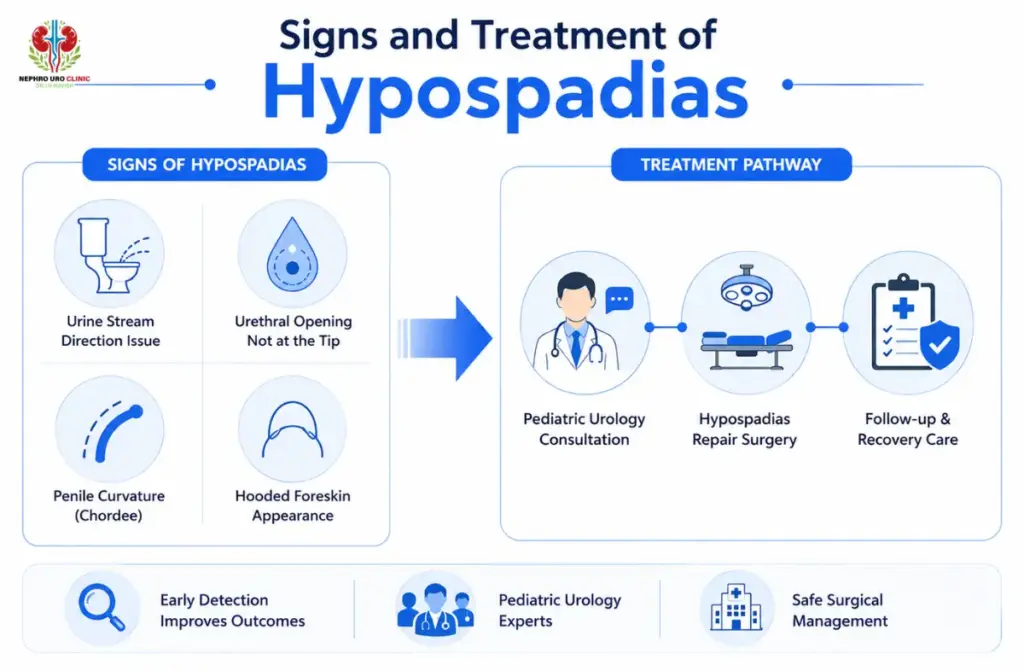
- Urethral opening located below the tip of the penis
- Downward curvature of the penis (chordee)
- Abnormal or spraying urine stream
- Incomplete or irregular foreskin
Diagnosis is confirmed through physical examination. In some cases, an ultrasound may be done to check for associated urinary tract abnormalities. Hormone tests are occasionally ordered for complex presentations.
Types of Hypospadias
Classification is based on where the urethral opening is located:
- Distal (Mild): Opening near the glans; single-stage repair is usually sufficient
- Midshaft (Moderate): Opening along the shaft; may involve some degree of curvature
- Proximal (Severe): Opening near the scrotum or perineum; often requires a staged repair approach
The type and severity directly determine the surgical technique and number of stages required.
Surgical Procedure
Surgery is performed under general anesthesia. The child is fully asleep and does not feel any pain during the procedure. Most hypospadias repairs are completed in 1 to 3 hours depending on complexity.
Common surgical techniques used:
- TIP Urethroplasty (Tubularized Incised Plate): The most widely used technique for distal and midshaft cases. The urethral plate is incised and tubularized to extend the urethra to the tip of the penis.
- Urethroplasty with graft: Tissue from the foreskin or buccal mucosa (inner cheek lining) is used to reconstruct the urethra in moderate to severe cases.
- Meatoplasty: A new urethral opening is created at the tip and the glans is reconstructed around it.
- Staged repair: Used for proximal hypospadias or when chordee is significant. The first stage corrects curvature and prepares tissue; the second stage completes the urethral reconstruction.
A urinary catheter is placed at the end of surgery and remains in place during the initial healing period.
Preoperative steps:
- Detailed consultation to review the child’s anatomy and select the appropriate technique
- Ultrasound or imaging if indicated
- Fasting instructions before the procedure
Postoperative care:
- Catheter and wound care instructions are given to parents before discharge
- Antibiotics and pain medication are prescribed as needed
- Strenuous activity is avoided during recovery
- Follow-up visits are scheduled to monitor healing and confirm urinary function
Most children return to normal activity within 2 to 4 weeks.
Risks and Complications
Complications are uncommon but can include:
- Urethrocutaneous fistula: A small opening between the repaired urethra and skin that allows urine leakage; may require a minor corrective procedure
- Urethral stricture: Scarring that narrows the urethra and affects urine flow
- Wound infection: Managed with antibiotics and proper wound care
- Residual chordee or incomplete repair: Rare; addressed with revision surgery if needed
When performed by an experienced urologist, success rates for hypospadias repair are high and most children have no long-term issues.
Benefits of Early Repair
- Restores a normal urine stream and allows the child to urinate standing up
- Corrects penile curvature before it affects development
- Prevents urinary tract infections associated with abnormal urine flow
- Reduces the risk of sexual dysfunction and fertility issues in adulthood
- Achieves a natural cosmetic appearance with minimal visible scarring
Cost of Hypospadias Surgery in Bengaluru
| Factor | Impact on Cost |
|---|---|
| Severity of condition | Proximal/staged repairs involve higher cost than distal single-stage |
| Surgical technique | Graft-based repairs may cost more than TIP urethroplasty |
| Hospital facility | Advanced surgical centers have higher charges |
| Surgeon experience | Specialist urologists with high case volume may charge a premium |
| Postoperative care | Catheter management, follow-up visits, medications |
Hypospadias repair surgery in Bengaluru generally ranges between ₹50,000 and ₹1,50,000. The final cost depends on the complexity of the case and the facilities used. Always confirm what is included in the quoted package, such as anesthesia, hospital stay, catheter care, and follow-up consultations.
Why Choose Dr. I. R. Ravish for Hypospadias Repair?
Dr. Ravish is a senior urologist at Nephro Uro Clinic and Sagar Hospitals, Bengaluru, with extensive experience in pediatric urology and reconstructive procedures. Parents from across Karnataka and neighboring states choose his practice for:
- High case volume in pediatric urological surgery
- Personalized surgical planning based on each child’s anatomy
- Clear communication with parents throughout the process
- Post-surgical support and structured follow-up care
Conclusion
From expert diagnosis to world-class treatment, hypospadias repair in Bengaluru offers the best care for this condition. Choosing Bengaluru ensures that your child receives the highest standard of medical attention, paving the way for a healthy future. Don’t wait—reach out to a specialist today and take the first step toward resolving this treatable condition.