
Quick Facts
| Procedure type | Minimally invasive, no external incision |
| Anesthesia | General or spinal |
| Typical duration | Under an hour for most cases, varies by stone size and number |
| Hospital stay | Usually day care, occasionally overnight |
| Stent placement | Sometimes needed, decided case by case |
| Cost range | ₹80,000 to ₹1,50,000, depending on individual case |
Why Ureteroscopy and Laser Treatment is Recommended
Ureteroscopy and laser treatment is recommended for kidney and ureteral stones that need active treatment rather than simply monitoring. The most common indications are:
Painful or Symptomatic Stones
Kidney stones can cause sharp pain, blood in urine, or trouble urinating. When a stone is causing these symptoms, ureteroscopy offers a way to clear it without open surgery.
Stones Too Large to Pass Naturally
Ureteroscopy can effectively treat many kidney and ureteral stones, particularly ones that are too large to pass on their own.
Stones Causing Blockage or Repeated Infection
Stones that are blocking urine flow or triggering repeated urinary infections need prompt treatment, since untreated obstruction combined with infection can escalate quickly (see “When to Seek Urgent Care” below).
Stones Located Higher in the Kidney
For stones sitting inside the kidney itself rather than the ureter, retrograde intrarenal surgery (RIRS) using a thin, flexible scope is often recommended instead of standard URS.
Recurrent or Multiple Stones
Some patients may need more than one procedure depending on stone size, number, and location. Your urologist will explain what to expect for your specific case after a scan and assessment.
Benefits of Ureteroscopy and Laser Treatment
- No external cuts, since the procedure is done through the natural urinary passage
- Can treat stones that are hard to reach with other methods
- Direct visual guidance for controlled, precise treatment
- Generally less pain and scarring compared to open surgery
- Day-care procedure for most patients, with a short hospital stay
Types of Treatment: URS and RIRS
There are two related approaches to ureteroscopy, and your doctor will choose the one that fits your case based on stone size, number, and exact location.
URS (Ureteroscopy)
Uses a rigid or semi-rigid scope and is mainly used for stones in the lower or mid ureter.
RIRS (Retrograde Intrarenal Surgery)
Uses a thin, flexible scope that can reach stones inside the kidney itself, not just the ureter. This approach is used when stones are higher up or harder to access.
Which Approach Is Right for You?
Your doctor will decide which approach fits your case based on the size, number, and exact location of your stones, following a scan and clinical assessment.
How the Procedure is Done
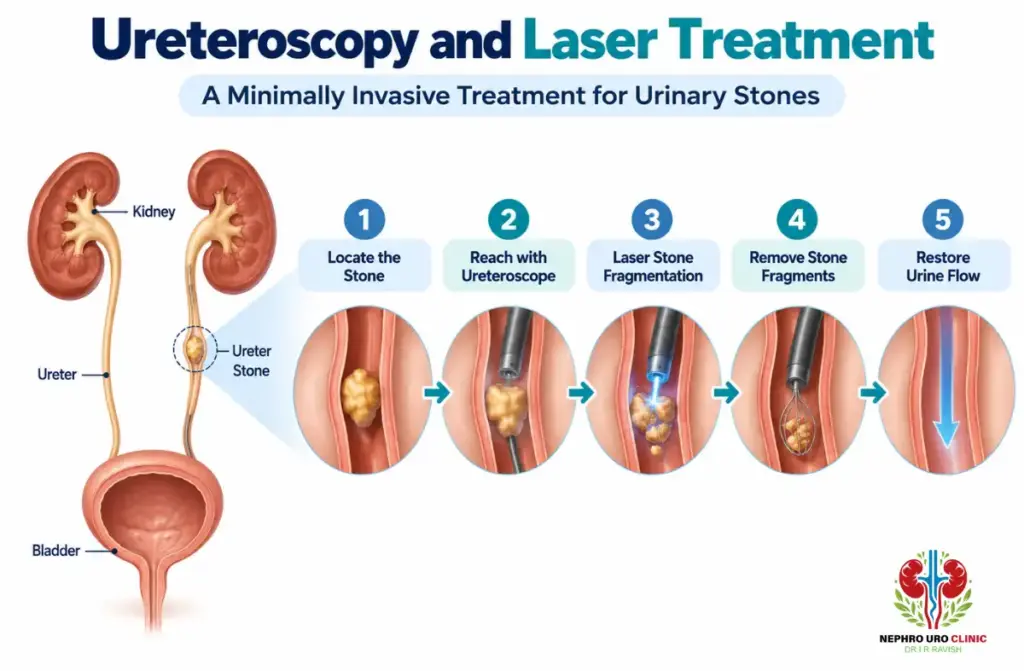
- Anesthesia. General or spinal anesthesia is used so you feel no pain during the procedure.
- Reaching the stone. The scope is passed through the urethra and bladder, then up into the ureter, and further into the kidney if needed.
- Locating the stone. A small camera at the tip lets the surgeon see the stone directly and check its size and position.
- Breaking the stone. A laser fiber is passed through the scope to break the stone into smaller fragments.
- Removing the pieces. Larger fragments may be removed with small instruments. Smaller pieces are often left to pass naturally in urine over the following days.
- Stent, if needed. A small tube called a stent may be placed temporarily inside the ureter to keep urine flowing while the area heals. Not every patient needs one.
How to Prepare for Ureteroscopy and Laser Treatment
- Share your full medical history with Dr. Ravish at consultation, including allergies, current medications, and conditions such as diabetes or a bleeding disorder
- Inform the team about all medications, including blood-thinning medicines such as aspirin, clopidogrel, or warfarin. These are paused before surgery based on Dr. Ravish’s specific instructions and should not be stopped without medical guidance
- Complete any imaging or urine tests your doctor has advised before the procedure date
- Follow fasting instructions if general anesthesia is planned, typically six to eight hours with no food or water
- Wear loose, comfortable clothing on the day of the procedure
- Arrange for someone to accompany you home, since general or spinal anesthesia is used
- Ask any questions before signing the consent form
Recovery and Aftercare
Many patients can return to light daily activities within a few days, although recovery time varies depending on the extent of the procedure and individual health.
- First few days: A mild burning sensation or light blood in urine is common and usually settles quickly. Prescribed pain relief is provided to manage any discomfort.
- Passing stone fragments: Any small remaining fragments may take days or longer to pass, depending on their size and location. This is separate from your general recovery, which usually feels normal well before all fragments have passed.
- Living with a stent: If your doctor places a stent, it is normal to notice urinary urgency, more frequent urination, or mild discomfort during urination while it is in place. Some patients also feel mild pain on one side of the lower back. These symptoms are common and usually settle once the stent is removed. Your urologist will advise you on when it should come out, which may range from a few days to several weeks depending on your case.
- Return to work: Many patients resume light daily activities within a few days; physically demanding jobs may need a few extra days of rest.
- Hydration and diet: Maintain good hydration unless your doctor has advised you to restrict fluids, and follow the dietary guidance your doctor gives you to lower the risk of new stones.
- Physical activity: Avoid heavy lifting or strenuous exercise for about a week, or as advised.
- Medication: Complete the full course of any prescribed medicine, even if you feel better early.
Risks and Safety Information
Ureteroscopy and laser treatment is a safe, well-established procedure with a low complication rate when performed by an experienced surgeon in a sterile setting. Possible risks include:
- Mild burning sensation or light blood in urine for a short period afterward
- Discomfort from a stent, if one is placed
- A small chance of injury to the ureter or infection
- A chance that some fragments remain and need a second procedure
These risks are kept low through careful surgical planning, experienced technique, and proper aftercare. Your urologist will go over the risks that apply to your specific case during your consultation.
When to Seek Urgent Care
If a kidney or ureteral stone is associated with fever, chills, or signs of infection along with urinary blockage, this needs urgent medical assessment. In some cases, the urinary tract may need to be drained first, before any definitive stone treatment is done. Do not wait if you have fever with stone symptoms — contact the clinic or go to an emergency department right away.
Also call your doctor promptly if you notice:
- Severe pain that does not improve with medicine
- Heavy or persistent bleeding in urine
- Inability to urinate
Cost of Ureteroscopy and Laser Treatment in Bengaluru
The ureteroscopy and laser treatment cost in Bengaluru usually ranges between ₹80,000 and ₹1,50,000. The exact figure depends on:
- The size, number, and location of the stones
- Whether RIRS or standard URS is required
- Whether a stent is placed
- The hospital’s facilities and the surgeon’s experience
- Anesthesia, hospital stay, and follow-up visits
Insurance and cashless treatment. Many patients use health insurance or TPA support for this procedure. Coverage depends on your specific policy. Speak with the clinic team about cashless facility options and documentation before your surgery date.
Disclaimer: Costs are approximate estimates. Since every case is different, a personal consultation is the only reliable way to get an accurate quote.
About Dr. I. R. Ravish
Dr. I. R. Ravish is a urologist with over 28 years of experience, holding MBBS, MS (General Surgery), and MCh (Urology) qualifications, along with a fellowship in pediatric urology completed in the United States. He has worked as a professor and medical director at leading hospitals in Bengaluru and has published research in national and international journals. He is experienced in laser-based and minimally invasive treatment for kidney stones, including both URS and RIRS techniques.
Dr. Ravish practices at Nephro Uro Clinic in Jayanagar, and is also associated with several hospitals across Bengaluru. Patient reviews and detailed background information are available on the clinic’s About Us and Testimonials pages.
Visit or Book a Consultation
Nephro Uro Clinic, No. 34, ground floor, 31st A Cross Rd, 7th Block, Jayanagar, Bengaluru, 560082. Phone: +91 88612 21822, Emergency: +91 82776 74213
If kidney stones are causing you pain, speak with Dr. I. R. Ravish for a proper diagnosis, an individual treatment plan, and an accurate cost estimate for your case.