
Genitourinary Cancer Surgeries

Genitourinary Cancer Surgeries

A cancer diagnosis changes everything. The questions come fast. What type is it? What stage? What happens next? If you or someone you love has been diagnosed with a genitourinary cancer, finding the right specialist quickly is what matters most.

Genitourinary cancers affect the organs of the urinary and reproductive systems. This includes the kidneys, bladder, prostate, testes, penis, and urethra. Each type behaves differently, responds to different treatments, and requires a different surgical approach.

Genitourinary cancer surgeries in Bengaluru have advanced significantly over the last decade. Minimally invasive techniques, robotic-assisted procedures, and specialist uro-oncology care are now available at dedicated clinics across the city. At Nephro Uro Clinic in Jayanagar and Sagar Hospitals in Tilaknagar, patients receive a thorough evaluation and a personalised treatment plan built around their specific diagnosis and stage. This guide covers everything you need to understand — from recognising early symptoms to knowing your full range of surgical and treatment options.

genitourinary cancer surgeries in Bangalore | Nephro Uro Clinic | Dr. I R Ravish

Types of Genitourinary Cancers

Genitourinary cancers are a group of cancers that develop in the urinary tract and the male and female reproductive systems. Understanding which organ is affected helps determine the right treatment path.

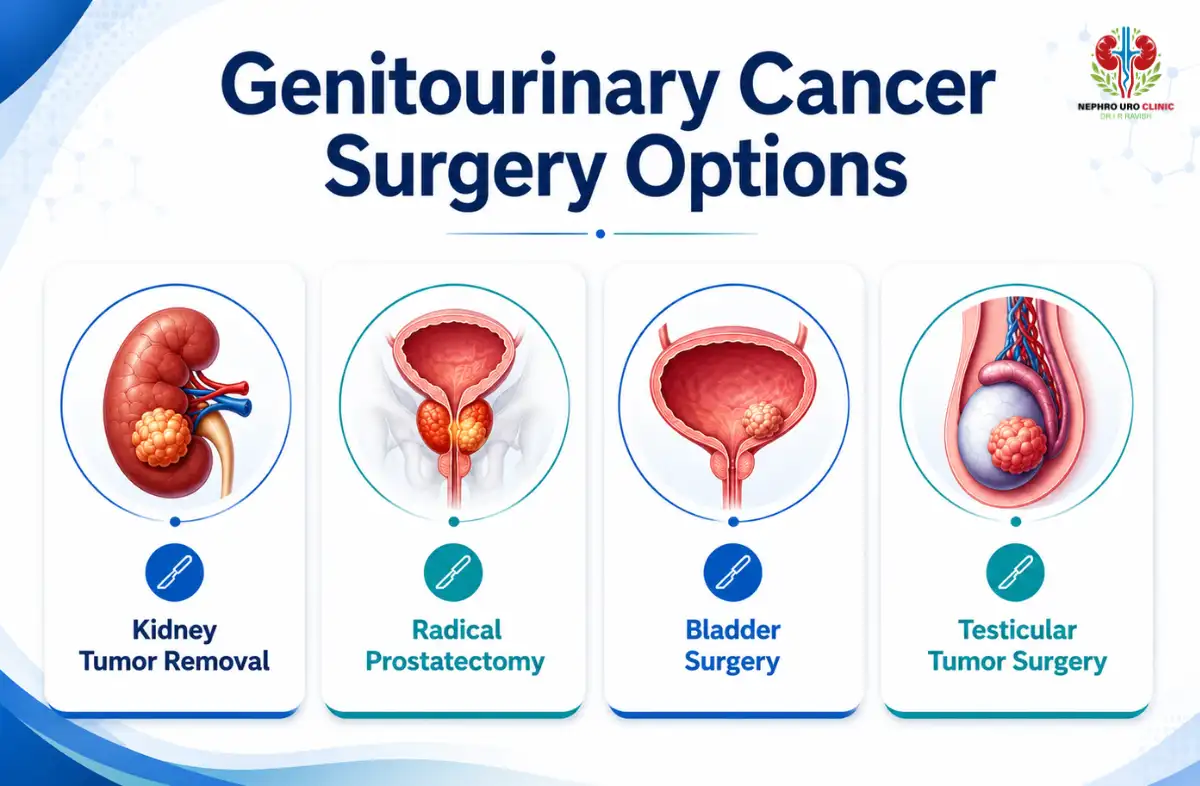
Kidney Cancer Kidney cancer, also called renal cell carcinoma, starts in the cells lining the small tubes inside the kidney. It is often found incidentally during an imaging scan done for another reason. When caught early, kidney cancer has a strong chance of successful treatment with surgery.

Bladder Cancer Bladder cancer develops in the inner lining of the bladder. The most common warning sign is blood in the urine, which may come and go. It is the most frequently diagnosed urinary tract cancer and responds well to early intervention. Transurethral resection of the bladder tumour (TURBT) is the standard first-line surgical procedure for bladder cancer.

Prostate Cancer Prostate cancer is the most common cancer in men over 50. Many cases grow slowly and may not require immediate surgery. Others are aggressive and need prompt treatment. A PSA blood test and biopsy confirm the diagnosis. Surgical options range from open prostatectomy to minimally invasive laparoscopic and robotic-assisted techniques.

Testicular Cancer Testicular cancer most commonly affects men in their 20s and 30s. It is one of the most treatable cancers when detected early. A painless lump or swelling in one testicle is the most common first sign. Most patients are cured with a combination of surgery and follow-up treatment.

Penile Cancer Penile cancer is rare but requires immediate medical attention. It most often appears as a sore, lump, or unusual growth on the skin of the penis. Early diagnosis is critical to preserving function and avoiding more extensive surgery.

Urethral Cancer Urethral cancer is among the rarest genitourinary cancers. It affects the tube that carries urine out of the body and can cause difficulty urinating, bleeding, or a lump in the area. Treatment depends on the location and extent of the tumour.

Symptoms of Genitourinary Cancer

Symptoms vary depending on which organ is affected. Some early warning signs are easy to dismiss as minor problems. Do not ignore them.

Seek medical attention if you notice any of the following:

Blood in the urine is the most important warning sign. It may look pink, red, or rust-coloured, and it may appear once and disappear. Do not wait for it to happen again before seeing a doctor.

Frequent or painful urination that is not caused by an infection can point to bladder, prostate, or urethral involvement. A burning sensation while urinating that does not respond to antibiotics should be investigated further.

A lump or swelling in the testicle, groin, or lower abdomen needs prompt evaluation. In younger men especially, a painless testicular lump is testicular cancer until proven otherwise.

Persistent lower back pain, particularly on one side, combined with blood in the urine can indicate kidney cancer.

Unexplained weight loss, ongoing fatigue, and loss of appetite that cannot be explained by another condition are general cancer warning signs that apply across all GU cancers.

If you are based in Jayanagar, Tilaknagar, or anywhere in Bengaluru and notice any of these symptoms, an early consultation at Nephro Uro Clinic can make a significant difference to your outcome.
Genitourinary Cancer Surgeries

Causes of Genitourinary Cancer

No single cause explains every case of genitourinary cancer. Most cases result from a combination of lifestyle, genetic, and environmental factors.

  • Smoking and tobacco use: are the leading modifiable risk factors for bladder cancer. Smokers are two to three times more likely to develop bladder cancer than non-smokers. Tobacco chemicals are filtered by the kidneys and stored in the bladder, where they damage the lining over time.
  • Prolonged exposure to industrial chemicals: particularly aromatic amines used in dye, rubber, and leather manufacturing, significantly raises bladder and kidney cancer risk.
  • Family history: plays a role in kidney and prostate cancer. Men with a first-degree relative diagnosed with prostate cancer are twice as likely to develop it themselves.
  • Chronic inflammation and infection: including long-term catheter use, recurrent urinary tract infections, and HPV infection, are linked to bladder and penile cancer respectively.
  • Age: increases risk across almost all genitourinary cancers. Prostate cancer is rare before 50. Kidney cancer peaks between 60 and 70. Testicular cancer is the exception, it is most common in younger men.
  • Obesity and a sedentary lifestyle: are associated with higher kidney cancer risk. Maintaining a healthy body weight and staying physically active are among the few modifiable factors known to reduce risk.

Diagnosis of Genitourinary Cancer

Reaching the right diagnosis quickly is the first step toward effective treatment. Several investigations are used together to confirm the presence of cancer, identify its type, and determine how far it has spread.

Urine Tests A urine cytology test checks for abnormal cancer cells shed into the urine. It is a simple, non-invasive first step for bladder and urethra cancer evaluation.

PSA Blood Test Prostate-specific antigen (PSA) is a protein produced by the prostate. Elevated PSA levels may indicate prostate cancer and trigger further investigation. PSA testing alone does not confirm cancer but guides the next steps.

Cystoscopy A thin flexible tube with a camera is passed into the bladder through the urethra to directly view the bladder lining. Any suspicious areas can be biopsied during the same procedure. Cystoscopy is the gold standard for diagnosing bladder cancer.

Imaging Tests Ultrasound, CT scans, and MRIs are used to locate tumours, assess their size, and determine whether cancer has spread to nearby lymph nodes or other organs. A CT urogram is commonly used for kidney and urinary tract cancers.

Biopsy A small sample of tissue is removed from the suspected area and examined under a microscope. A biopsy confirms the cancer type and grade, meaning how aggressive the cells look, which directly guides treatment decisions.

TURBT — Diagnostic and Therapeutic For bladder cancer specifically, TURBT (Transurethral Resection of Bladder Tumour) serves both as a diagnostic tool and an initial treatment. The tumour is removed endoscopically and sent for pathological analysis to determine depth of invasion and grade.

Treatment of Genitourinary Cancer

Treatment options for genitourinary cancers depend on the type and stage of cancer. Common treatments include:

  • Surgery: Removes the tumor and surrounding tissues.
  • Radiation Therapy: Targets and destroys cancer cells using high-energy rays.
  • Chemotherapy: Involves drugs to kill or stop the growth of cancer cells.
  • Immunotherapy: Boosts the immune system to fight cancer.
  • Targeted Therapy: Focuses on specific cancer-causing proteins or genes.

Specialized centers for genitourinary cancer surgeries in Jayanagar and Tilak Nagar provide personalized care plans that combine multiple treatment methods. The cost of genitourinary cancer surgeries in Bengaluru varies, but affordable options are available without compromising quality.

Cancer Staging and What It Means for Your Treatment

Before any treatment begins, your cancer is assigned a stage. Staging describes how large the tumour is and whether it has spread beyond the original organ.

Stages run from Stage 1 to Stage 4. Stage 1 means the cancer is small and confined to the organ where it started. Stage 4 means it has spread to distant organs or lymph nodes. Stage 2 and 3 fall in between, indicating local spread to surrounding tissue or nearby lymph nodes.

Stage affects everything: which surgery is appropriate, whether chemotherapy or radiation is needed alongside surgery, and what the expected outcomes are. This is why getting a proper staging workup — including imaging and pathology — before any treatment decision is essential.

For bladder cancer specifically, the distinction between non-muscle-invasive (Stages 1 and below) and muscle-invasive (Stage 2 and above) is the single most important factor in determining treatment. Non-muscle-invasive cases can often be treated with TURBT and intravesical therapy alone. Muscle-invasive cases typically require radical cystectomy.

Risk Factors of Genitourinary Cancer

Key risk factors include:

  • Smoking and tobacco use
  • Chronic urinary infections
  • Age (more common in older adults)
  • Family history of cancer
  • Occupational exposure to chemicals

Hospitals in Bengaluru often encourage patients to adopt healthy lifestyles to minimize these risks. Screening programs in areas like Jayanagar and Tilak Nagar play a vital role in early detection and prevention.

What to Expect at Your First Consultation

If you have been referred for a suspected genitourinary cancer, or if you have noticed symptoms and want to get checked, here is what your first visit typically involves.

Dr. Ravish will review your symptom history, any prior test results, and your family history. A physical examination is performed. Based on this, he will recommend specific investigations — which may include a urine test, blood test, ultrasound, or cystoscopy — to confirm or rule out a diagnosis.

If cancer is confirmed, a staging plan is put in place. You will receive a clear explanation of the findings, the treatment options available for your specific case, the expected outcomes, and what recovery looks like. No decisions are rushed. Every question you have will be answered before any next step is taken.

Consultations are available at Nephro Uro Clinic, No. 34, Ground Floor, 31st A Cross Road, 7th Block, Jayanagar, Bengaluru 560082, and at Sagar Hospitals, 44/54, 30th Cross, Tilaknagar, Bengaluru 560041.

Conclusion

A genitourinary cancer diagnosis is serious. But with the right specialist, the right diagnosis, and a treatment plan built specifically for your case, many patients go on to live full, healthy lives.

Dr. I. R. Ravish, MCh Urology, with 28 years of experience in urological surgery, sees patients at Nephro Uro Clinic, Jayanagar, and Sagar Hospitals, Tilaknagar, Bengaluru. If you have symptoms that concern you, or if you have already received a diagnosis and want a specialist opinion, do not delay. Early action gives you the best chance at the best outcome.

Book Appointment

A cancer diagnosis changes everything. The questions come fast. What type is it? What stage? What happens next? If you or someone you love has been diagnosed with a genitourinary cancer, finding the right specialist quickly is what matters most.

Genitourinary cancers affect the organs of the urinary and reproductive systems. This includes the kidneys, bladder, prostate, testes, penis, and urethra. Each type behaves differently, responds to different treatments, and requires a different surgical approach.

Genitourinary cancer surgeries in Bengaluru have advanced significantly over the last decade. Minimally invasive techniques, robotic-assisted procedures, and specialist uro-oncology care are now available at dedicated clinics across the city. At Nephro Uro Clinic in Jayanagar and Sagar Hospitals in Tilaknagar, patients receive a thorough evaluation and a personalised treatment plan built around their specific diagnosis and stage. This guide covers everything you need to understand — from recognising early symptoms to knowing your full range of surgical and treatment options.

Types of Genitourinary Cancers

Genitourinary cancers are a group of cancers that develop in the urinary tract and the male and female reproductive systems. Understanding which organ is affected helps determine the right treatment path.

Kidney Cancer Kidney cancer, also called renal cell carcinoma, starts in the cells lining the small tubes inside the kidney. It is often found incidentally during an imaging scan done for another reason. When caught early, kidney cancer has a strong chance of successful treatment with surgery.

Bladder Cancer Bladder cancer develops in the inner lining of the bladder. The most common warning sign is blood in the urine, which may come and go. It is the most frequently diagnosed urinary tract cancer and responds well to early intervention. Transurethral resection of the bladder tumour (TURBT) is the standard first-line surgical procedure for bladder cancer.

Prostate Cancer Prostate cancer is the most common cancer in men over 50. Many cases grow slowly and may not require immediate surgery. Others are aggressive and need prompt treatment. A PSA blood test and biopsy confirm the diagnosis. Surgical options range from open prostatectomy to minimally invasive laparoscopic and robotic-assisted techniques.

Testicular Cancer Testicular cancer most commonly affects men in their 20s and 30s. It is one of the most treatable cancers when detected early. A painless lump or swelling in one testicle is the most common first sign. Most patients are cured with a combination of surgery and follow-up treatment.

Penile Cancer Penile cancer is rare but requires immediate medical attention. It most often appears as a sore, lump, or unusual growth on the skin of the penis. Early diagnosis is critical to preserving function and avoiding more extensive surgery.

Urethral Cancer Urethral cancer is among the rarest genitourinary cancers. It affects the tube that carries urine out of the body and can cause difficulty urinating, bleeding, or a lump in the area. Treatment depends on the location and extent of the tumour.

Symptoms of Genitourinary Cancer

Symptoms vary depending on which organ is affected. Some early warning signs are easy to dismiss as minor problems. Do not ignore them.

Seek medical attention if you notice any of the following:

Blood in the urine is the most important warning sign. It may look pink, red, or rust-coloured, and it may appear once and disappear. Do not wait for it to happen again before seeing a doctor.

Frequent or painful urination that is not caused by an infection can point to bladder, prostate, or urethral involvement. A burning sensation while urinating that does not respond to antibiotics should be investigated further.

A lump or swelling in the testicle, groin, or lower abdomen needs prompt evaluation. In younger men especially, a painless testicular lump is testicular cancer until proven otherwise.

Persistent lower back pain, particularly on one side, combined with blood in the urine can indicate kidney cancer.

Unexplained weight loss, ongoing fatigue, and loss of appetite that cannot be explained by another condition are general cancer warning signs that apply across all GU cancers.

If you are based in Jayanagar, Tilaknagar, or anywhere in Bengaluru and notice any of these symptoms, an early consultation at Nephro Uro Clinic can make a significant difference to your outcome.

Genitourinary Cancer Surgeries

Causes of Genitourinary Cancer

No single cause explains every case of genitourinary cancer. Most cases result from a combination of lifestyle, genetic, and environmental factors.

  • Smoking and tobacco use: are the leading modifiable risk factors for bladder cancer. Smokers are two to three times more likely to develop bladder cancer than non-smokers. Tobacco chemicals are filtered by the kidneys and stored in the bladder, where they damage the lining over time.
  • Prolonged exposure to industrial chemicals: particularly aromatic amines used in dye, rubber, and leather manufacturing, significantly raises bladder and kidney cancer risk.
  • Family history: plays a role in kidney and prostate cancer. Men with a first-degree relative diagnosed with prostate cancer are twice as likely to develop it themselves.
  • Chronic inflammation and infection: including long-term catheter use, recurrent urinary tract infections, and HPV infection, are linked to bladder and penile cancer respectively.
  • Age: increases risk across almost all genitourinary cancers. Prostate cancer is rare before 50. Kidney cancer peaks between 60 and 70. Testicular cancer is the exception, it is most common in younger men.
  • Obesity and a sedentary lifestyle: are associated with higher kidney cancer risk. Maintaining a healthy body weight and staying physically active are among the few modifiable factors known to reduce risk.

Diagnosis of Genitourinary Cancer

Reaching the right diagnosis quickly is the first step toward effective treatment. Several investigations are used together to confirm the presence of cancer, identify its type, and determine how far it has spread.

Urine Tests A urine cytology test checks for abnormal cancer cells shed into the urine. It is a simple, non-invasive first step for bladder and urethra cancer evaluation.

PSA Blood Test Prostate-specific antigen (PSA) is a protein produced by the prostate. Elevated PSA levels may indicate prostate cancer and trigger further investigation. PSA testing alone does not confirm cancer but guides the next steps.

Cystoscopy A thin flexible tube with a camera is passed into the bladder through the urethra to directly view the bladder lining. Any suspicious areas can be biopsied during the same procedure. Cystoscopy is the gold standard for diagnosing bladder cancer.

Imaging Tests Ultrasound, CT scans, and MRIs are used to locate tumours, assess their size, and determine whether cancer has spread to nearby lymph nodes or other organs. A CT urogram is commonly used for kidney and urinary tract cancers.

Biopsy A small sample of tissue is removed from the suspected area and examined under a microscope. A biopsy confirms the cancer type and grade, meaning how aggressive the cells look, which directly guides treatment decisions.

TURBT — Diagnostic and Therapeutic For bladder cancer specifically, TURBT (Transurethral Resection of Bladder Tumour) serves both as a diagnostic tool and an initial treatment. The tumour is removed endoscopically and sent for pathological analysis to determine depth of invasion and grade.

Treatment of Genitourinary Cancer

Treatment options for genitourinary cancers depend on the type and stage of cancer. Common treatments include:

  • Surgery: Removes the tumor and surrounding tissues.
  • Radiation Therapy: Targets and destroys cancer cells using high-energy rays.
  • Chemotherapy: Involves drugs to kill or stop the growth of cancer cells.
  • Immunotherapy: Boosts the immune system to fight cancer.
  • Targeted Therapy: Focuses on specific cancer-causing proteins or genes.

Specialized centers for genitourinary cancer surgeries in Jayanagar and Tilak Nagar provide personalized care plans that combine multiple treatment methods. The cost of genitourinary cancer surgeries in Bengaluru varies, but affordable options are available without compromising quality.

Cancer Staging and What It Means for Your Treatment

Before any treatment begins, your cancer is assigned a stage. Staging describes how large the tumour is and whether it has spread beyond the original organ.

Stages run from Stage 1 to Stage 4. Stage 1 means the cancer is small and confined to the organ where it started. Stage 4 means it has spread to distant organs or lymph nodes. Stage 2 and 3 fall in between, indicating local spread to surrounding tissue or nearby lymph nodes.

Stage affects everything: which surgery is appropriate, whether chemotherapy or radiation is needed alongside surgery, and what the expected outcomes are. This is why getting a proper staging workup — including imaging and pathology — before any treatment decision is essential.

For bladder cancer specifically, the distinction between non-muscle-invasive (Stages 1 and below) and muscle-invasive (Stage 2 and above) is the single most important factor in determining treatment. Non-muscle-invasive cases can often be treated with TURBT and intravesical therapy alone. Muscle-invasive cases typically require radical cystectomy.

Risk Factors of Genitourinary Cancer

Key risk factors include:

  • Smoking and tobacco use
  • Chronic urinary infections
  • Age (more common in older adults)
  • Family history of cancer
  • Occupational exposure to chemicals

Hospitals in Bengaluru often encourage patients to adopt healthy lifestyles to minimize these risks. Screening programs in areas like Jayanagar and Tilak Nagar play a vital role in early detection and prevention.

What to Expect at Your First Consultation

If you have been referred for a suspected genitourinary cancer, or if you have noticed symptoms and want to get checked, here is what your first visit typically involves.

Dr. Ravish will review your symptom history, any prior test results, and your family history. A physical examination is performed. Based on this, he will recommend specific investigations — which may include a urine test, blood test, ultrasound, or cystoscopy — to confirm or rule out a diagnosis.

If cancer is confirmed, a staging plan is put in place. You will receive a clear explanation of the findings, the treatment options available for your specific case, the expected outcomes, and what recovery looks like. No decisions are rushed. Every question you have will be answered before any next step is taken.

Consultations are available at Nephro Uro Clinic, No. 34, Ground Floor, 31st A Cross Road, 7th Block, Jayanagar, Bengaluru 560082, and at Sagar Hospitals, 44/54, 30th Cross, Tilaknagar, Bengaluru 560041.

Conclusion

A genitourinary cancer diagnosis is serious. But with the right specialist, the right diagnosis, and a treatment plan built specifically for your case, many patients go on to live full, healthy lives.

Dr. I. R. Ravish, MCh Urology, with 28 years of experience in urological surgery, sees patients at Nephro Uro Clinic, Jayanagar, and Sagar Hospitals, Tilaknagar, Bengaluru. If you have symptoms that concern you, or if you have already received a diagnosis and want a specialist opinion, do not delay. Early action gives you the best chance at the best outcome.

Frequently Asked Questions

Genitourinary cancer is treated through surgery, chemotherapy, radiation therapy, or targeted therapies, depending on the cancer type and stage. Early diagnosis is key to effective treatment, often involving a combination of these methods. Consulting a specialist ensures a personalized treatment plan.

The most common genitourinary cancer is prostate cancer, especially in men over 50. Early detection through routine screenings significantly improves treatment outcomes. Other common types include bladder cancer and kidney cancer, which are also treatable if caught early.

Yes, kidney cancer is classified as a genitourinary cancer. It originates in the kidneys and is commonly detected through imaging tests and blood work. With advancements in surgery and treatment, kidney cancer has a high survival rate when diagnosed early.