Kidney stone pain is often described as one of the most intense pains a person can experience. It can start suddenly. It can stop you in the middle of work. It can wake you up at night. Many patients in Bengaluru come to the clinic worried and confused. Some hope the pain will pass. Others fear surgery immediately. The good news is that most kidney stones are treatable. With timely care, serious complications can be avoided.
Today, kidney stone treatment in Bengaluru includes both non-surgical and minimally invasive options. The right choice depends on the size of the stone, its location, your symptoms, and your overall health. If you live in areas like Jayanagar or Tilaknagar and are experiencing symptoms, early evaluation makes a real difference. Prompt care reduces pain, protects kidney function, and prevents repeat episodes.
What Are Kidney Stones?
Kidney stones are hard deposits made of minerals and salts. They form inside the kidneys when urine becomes too concentrated. When you do not drink enough water, certain substances in the urine can stick together and slowly form crystals. Over time, these crystals grow into stones.
Some stones stay in the kidney without causing problems. Others move into the ureter, the tube connecting the kidney to the bladder. This movement often causes severe pain. Think of it like sand collecting in a pipe. If the particles are small, they pass out easily. If they are larger, they block the flow and cause pressure and pain.
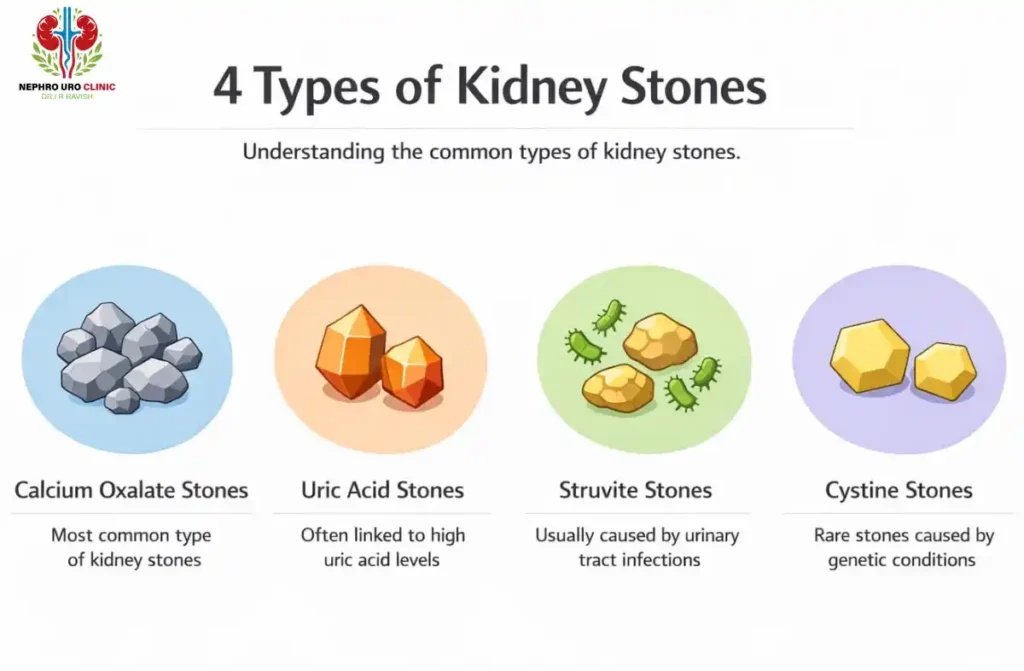
Types of Kidney Stones
- Calcium stones: The most common type. Often linked to dehydration or high salt intake. They may form when calcium combines with oxalate or phosphate in the urine.
- Uric acid stones: More common in people who eat a high-protein diet or have gout. They tend to form when urine is consistently too acidic.
- Struvite stones: Usually related to repeated urinary infections. These stones can grow quickly and may become quite large if not treated early.
- Cystine stones: Rare. Caused by an inherited condition. They develop when the kidneys leak an amino acid called cystine into the urine.
Knowing the type of stone helps your doctor choose the right treatment and suggest specific lifestyle changes to reduce the risk of it coming back.
Common Symptoms of Kidney Stones
Kidney stones do not always cause symptoms at first. Some people may not even know they have a stone until it starts moving. Pain usually begins when the stone travels from the kidney into the ureter and blocks the flow of urine. The intensity of symptoms can vary from mild discomfort to severe, sudden pain that needs urgent care.
Common symptoms include:
- Severe pain in the back or side
- Pain spreading to the lower abdomen or groin
- Burning sensation while passing urine
- Blood in urine (pink, red, or brown color)
- Frequent urge to urinate
- Nausea or vomiting
- Fever with chills (this needs immediate medical attention)
Causes and Risk Factors
- Not drinking enough water
- Living in hot climates like Bengaluru
- High salt diet
- Excess animal protein intake
- Obesity
- Family history of kidney stones
- Recurrent urinary infections
- Certain medical conditions like gout
A common example is someone working long hours outdoors without enough fluids. Over time, concentrated urine increases the risk of stone formation.
Diagnosis of Kidney Stones
Diagnosis begins with a careful discussion of symptoms. Your doctor will ask about the pattern of pain, urinary changes, and medical history. A urine test checks for infection and blood. Blood tests assess kidney function. Imaging is important. Ultrasound is often the first step. In some cases, a CT scan provides more detail about stone size and location.
Accurate diagnosis helps decide whether the stone can pass naturally or needs intervention. It also helps rule out other causes of abdominal pain.
Kidney Stone Treatment Options in Bengaluru
Kidney stone treatment in Bengaluru depends on the size of the stone, its location, the level of pain, and whether there is infection or blockage. Not every stone needs surgery. The treatment plan is chosen after careful evaluation and discussion with the patient.
1. Conservative Treatment
Small kidney stones can often pass on their own. In such cases, the focus is on increasing fluid intake, giving pain relief, and prescribing medicines that help relax the urinary tract so the stone can pass more easily. Regular follow-up scans are done to ensure the stone is moving and not causing complications. Medical supervision during this period is important to prevent infection or worsening pain.
2. Shock Wave Therapy (ESWL)
Shock Wave Therapy uses focused sound waves from outside the body to break the stone into smaller fragments. These smaller pieces then pass naturally through urine over the next few days or weeks. There are no surgical cuts involved. This option is usually suitable for selected small to medium-sized stones.
3. Ureteroscopy (URS)
In ureteroscopy, a thin instrument is gently passed through the natural urinary passage to reach the stone. The stone is then broken into small pieces and removed. There are no external incisions on the body. This method is commonly used when the stone is stuck in the ureter and causing severe pain.
4. Retrograde Intrarenal Surgery (RIRS)
RIRS is a minimally invasive procedure where a flexible scope is guided up to the kidney through the urinary passage. A laser is used to break the stone into fine fragments. It is often chosen for stones located inside the kidney that cannot pass naturally. Recovery is usually quicker compared to traditional surgery.
5. Percutaneous Nephrolithotomy (PCNL)
PCNL is recommended for larger stones that cannot be treated with simpler methods. A small incision is made in the back to directly access and remove the stone from the kidney. Though it is a surgical procedure, it is performed using modern techniques that aim to reduce discomfort and hospital stay.
The overall goal of kidney stone treatment in Bengaluru is complete stone clearance while ensuring safety, comfort, and protection of long-term kidney function.
Thulium Fibre Laser vs Holmium Laser: Which Is Used and Why
Both Thulium fibre laser and Holmium laser are used in modern kidney stone treatment, but they differ in precision and recovery.
- Holmium Laser: The long-standing standard for RIRS and URS procedures. Effective on stones of all compositions, with a strong safety record built over two decades of use.
- Thulium Fibre Laser: A newer technology offering finer fragmentation, lower thermal damage to surrounding tissue, and potentially faster stone clearance for select cases.
Dr. Ravish evaluates stone size, location, and composition to determine which laser technology is appropriate for each patient.
What Happens During the Laser Procedure (Step by Step)
- Anaesthesia: The procedure is performed under general or spinal anaesthesia, so the patient feels no pain.
- Scope Insertion: A thin scope is passed through the urinary tract to reach the stone — no external incision is required.
- Laser Fragmentation: The laser fibre breaks the stone into small fragments or dust.
- Fragment Removal: Larger fragments are removed with a basket; smaller dust passes naturally with urine.
- Stent Placement (if needed): A DJ stent may be placed to support healing and drainage.
- Recovery: Most patients go home the same day or after one night of observation.
DJ Stent After Kidney Stone Surgery: What to Expect
After URS or RIRS, many patients have a DJ (Double-J) stent placed temporarily inside the ureter. This small, flexible tube keeps the urinary tract open and supports healing while swelling subsides.
What patients commonly experience with a stent:
- Mild discomfort in the side or lower abdomen
- A frequent urge to urinate
- Occasional light blood in urine
- Mild discomfort during physical activity
How long does it stay in?
A DJ stent is typically removed 1–2 weeks after the procedure during a quick outpatient visit.
When to contact the clinic:
Fever, severe pain, or inability to urinate after stent placement should be reported to Dr. Ravish’s team immediately.
Why Choose Nephro Uro Clinic for Kidney Stone Treatment in Bengaluru?
Choosing the right urologist matters when you are dealing with severe pain or repeated kidney stones. At Nephro Uro Clinic, care is led by Dr. I. R. Ravish (MBBS, MS, MCh – Urology, Fellowship in Pediatric Urology, USA), a senior urology specialist with over 28 years of total medical practice, including more than 20 years of dedicated urology experience.
Dr. I. R. Ravish has trained internationally and has served as Professor in Urology departments. He has also been Medical Director at leading hospitals in Bengaluru and continues to practice at reputed multi-specialty centers across the city. His clinical experience includes advanced kidney stone management, prostate procedures, kidney transplant surgeries, and male infertility treatments.
When it comes to kidney stone treatment, he is especially known for:
- Expertise in minimally invasive and endoscopic procedures
- Extensive experience in laser-based stone removal
- Strong focus on patient safety and comfort
- Personalized treatment planning instead of a one-size-fits-all approach
He has received recognition at national and international platforms, including awards for academic excellence and surgical contributions. However, what matters most to patients is clear communication. Every patient is carefully evaluated before suggesting any procedure. Treatment options are explained in simple language, so families can make informed decisions without confusion.
Many patients from Jayanagar, Tilaknagar, and nearby areas choose Nephro Uro Clinic for kidney stone treatment because of the balanced approach. The focus is not only on removing the stone but also on understanding why it formed and how to prevent it from coming back. The goal is long-term kidney health, reduced recurrence, and safe recovery — guided by experience and steady clinical judgment.
Cost of Kidney Stone Treatment in Bengaluru
The cost varies depending on:
- Size and number of stones
- Type of procedure needed
- Length of hospital stay
- Associated medical conditions
For example, a small stone treated with medication will cost much less than a large stone requiring surgery. Similarly, kidney stone laser treatment cost in Bengaluru may differ based on complexity.
Kidney stone treatment costs in Bengaluru typically range based on procedure complexity, stone size, and hospital stay duration. Exact pricing depends on individual diagnosis.
Disclaimer: The above is a general estimate only. Final cost is determined after consultation and diagnostic evaluation with Dr. Ravish.
How to Prevent Kidney Stones
Kidney stones are not a one-time event for most patients. Studies show that without preventive measures, up to 50% of patients experience a recurrence within 5 to 10 years. This is why Dr. Ravish emphasises a personalised prevention plan — including hydration targets, dietary adjustments, and periodic screening — for every patient after treatment.
- Drink at least 2.5 to 3 liters of water daily: Adequate water intake keeps urine diluted and helps flush out minerals before they form crystals.
- Reduce salt intake: High salt increases calcium levels in urine, which raises the risk of stone formation.
- Limit excessive red meat: Too much animal protein can make urine more acidic, encouraging certain types of stones.
- Maintain healthy body weight: Obesity is linked to changes in urine composition that increase stone risk.
- Avoid holding urine for long periods: Regular urination helps prevent concentration of stone-forming substances.
- Treat urinary infections early: Prompt treatment reduces the risk of infection-related stones.
- Follow up regularly if you have had stones before: Periodic check-ups help detect early recurrence and allow preventive steps in time.
Simple lifestyle changes make a real difference. Prevention is always easier than repeat treatment.
When Should You See a Doctor for Kidney Stones?
Kidney stone pain can come and go. Some stones pass on their own. But not every situation is safe to wait and watch. Knowing when to seek medical care can prevent complications and reduce unnecessary suffering.
You should consider seeing a doctor if your symptoms feel different from a mild, short-lived discomfort. Trust your body. If something feels intense, persistent, or unusual, it deserves attention.
Severe or Uncontrolled Pain
Pain from kidney stones is often sharp and can spread from the back to the lower abdomen or groin. If the pain is strong enough to stop your daily routine, disturb sleep, or does not improve with basic pain relief, medical care is needed. Severe pain may mean the stone is blocking urine flow.
Pain Lasting More Than a Few Hours
A brief episode of pain may settle as the stone moves. But if pain continues for several hours without relief, it is safer to get evaluated. Ongoing pain can indicate that the stone is stuck and not passing naturally.
Fever or Chills
Fever with kidney stone symptoms is not something to ignore. It may signal an infection in the urinary tract. When infection and blockage happen together, it can become serious quickly. This situation needs urgent medical attention.
Blood in Urine
You may notice pink, red, or brown discoloration in your urine. This can happen when a stone irritates the urinary tract. While small amounts can occur, visible blood should always be checked to understand the cause and severity.
Nausea or Vomiting
Some people feel nauseated or may vomit due to severe pain or irritation. If you are unable to keep fluids down, dehydration can worsen the condition. Medical support helps control symptoms and maintain hydration.
Difficulty Passing Urine
If you feel the urge to urinate but cannot pass urine easily, or if the flow is reduced, it may mean there is a blockage. This needs prompt evaluation to protect kidney function.
History of Kidney Stones
If you have had kidney stones before, new symptoms should not be ignored. Repeat episodes are common, and early care can help manage the stone before it becomes more painful or complicated.
Existing Health Conditions
People with diabetes, kidney disease, or weakened immunity should seek medical advice earlier. In these cases, even mild symptoms can progress faster and need closer monitoring.
A Simple Way to Think About It
If the pain is manageable, short-lived, and you are otherwise comfortable, you may be able to observe for a short time. But if symptoms are severe, persistent, or associated with fever, vomiting, or difficulty passing urine, it is best to see a doctor without delay.
Early evaluation does not always mean surgery. In many cases, it simply helps confirm what is happening and guides the safest, most effective treatment.
Conclusion
Kidney stones are painful but manageable. Early diagnosis and the right treatment approach protect kidney health and reduce complications. Today, treatment options in Bengaluru include effective non-surgical and minimally invasive methods tailored to each patient. If you notice symptoms like severe back pain or blood in urine, do not ignore them. A timely consultation can prevent bigger problems. Speaking with an experienced urologist is the first step toward the right care.
If you or a family member is experiencing symptoms, consider scheduling a consultation at Nephro Uro Clinic. Early care brings relief, reassurance, and better long-term health.