A quick note before you read on. Kidney transplant pricing varies a lot between hospitals, and even between two patients at the same hospital. Every number in this guide is a general estimate meant to help you plan and ask the right questions. It is not a quote, and it should not replace a written estimate from your chosen hospital.
A kidney transplant is a life saving option for people with advanced kidney disease. It often gives a better quality of life than long term dialysis. Bengaluru has grown into one of India’s leading cities for kidney transplant care, with several well known hospitals and experienced transplant teams. Still, the kidney transplant cost in Bengaluru is something most families want to understand before they start the journey. This guide walks you through what usually goes into that cost, what affects it, and how you can plan for it.
What Goes Into the Cost of a Kidney Transplant
A kidney transplant bill is not one single number. It is built from several parts, and hospitals bundle these parts differently, so two quotes that look very different on paper can sometimes cover similar ground. Here is a general idea of what usually makes up the total.
Pre transplant evaluation. Before surgery, both the patient and the potential donor go through a detailed set of tests. This usually includes tissue typing to check how well matched the donor and recipient are, blood cross-matching, detailed scans of the donor’s kidneys to map the blood vessels before surgery, and screening for infections and other health conditions. A thorough evaluation for both sides together often falls somewhere between ₹1,00,000 and ₹1,50,000, though the exact amount depends on the tests needed and some hospitals fold part of this into their overall package.
The transplant package. This usually covers the donor’s operation, the recipient’s operation, the surgical team, operation theatre charges, and anesthesia. This tends to be the largest single part of the bill, though the exact figure varies a great deal between hospitals depending on what is included.
Hospital stay and ICU care, if not already part of the package. Most patients stay in hospital for one to two weeks after surgery, with a short stretch of that in the ICU. Ask whether your quoted package already includes this, since some do and some do not.
Medicines. This is one of the most misunderstood parts of the cost. After transplant, you will be on a combination of anti rejection medicines for life. Many patients also need extra medicine right around the time of surgery to help the body accept the new kidney, along with regular blood tests to check that medicine levels are right.
Because of all this, first year medicine costs often run higher than many patients expect, commonly somewhere between ₹2,00,000 and ₹4,00,000, and sometimes more depending on the medicines used and whether there are any complications. This is a planning estimate, not a guaranteed figure, since it can vary a lot between patients. After the first year, costs usually settle down, often to somewhere around ₹1,00,000 to ₹1,50,000 a year, though this too varies and is a lifelong expense.
Possible complications. An infection, a rejection episode, or a longer ICU stay can add meaningfully to the bill. This is hard to predict in advance, which is one more reason to keep some contingency funds set aside.
Donor related costs and travel. If your donor or you are travelling from outside Bengaluru, factor in accommodation, food, and daily expenses during evaluation, surgery, and recovery.
Because hospitals bundle these pieces so differently, published estimates for a kidney transplant in Bengaluru vary widely, with some hospitals quoting figures as low as ₹3 lakh for a base package and others quoting ₹15 lakh or more once every component is included. The only reliable way to know your real number is to ask your chosen hospital for a written, itemised estimate that spells out exactly what is and is not covered.
What Major Hospitals Typically Include
Bengaluru is home to several well established transplant centers, including large hospital chains and dedicated kidney and urology hospitals. Rather than comparing headline prices between them, which can be misleading since one hospital’s quote might exclude pre transplant evaluation while another’s includes it, it helps to ask every hospital the same set of questions:
- Does this estimate include both the donor’s and the recipient’s evaluation?
- Does it include the surgery for both the donor and the recipient?
- How many days of hospital stay and ICU care are included?
- Are first year medicines included, or billed separately?
- What happens to the cost if there is a complication or a longer stay?
Comparing answers to these questions across two or three hospitals will give you a far more accurate picture than comparing headline numbers alone.
Paying for It: Insurance and Other Support
The kidney transplant cost in Bengaluru can feel overwhelming at first, but there are usually more ways to manage it than families realise.
- Health insurance. Many policies cover transplant surgery and hospital charges, and some hospitals offer cashless treatment with partner insurers.
- Government schemes. Programs such as Ayushman Bharat, along with some Karnataka state schemes, support eligible low income patients, occasionally covering the full cost.
- NGO support. Several non profit organisations in the city help connect patients with funding or sponsors.
- Crowdfunding and medical loans. Many families raise part of the cost online or use a medical loan or EMI plan.
- Hospital financial counselors. Most transplant centers have someone on staff who can walk you through costs, paperwork, and what support you may qualify for.
Talking to a financial counselor early, alongside your consultation with a urologist, often makes the whole process feel less overwhelming.
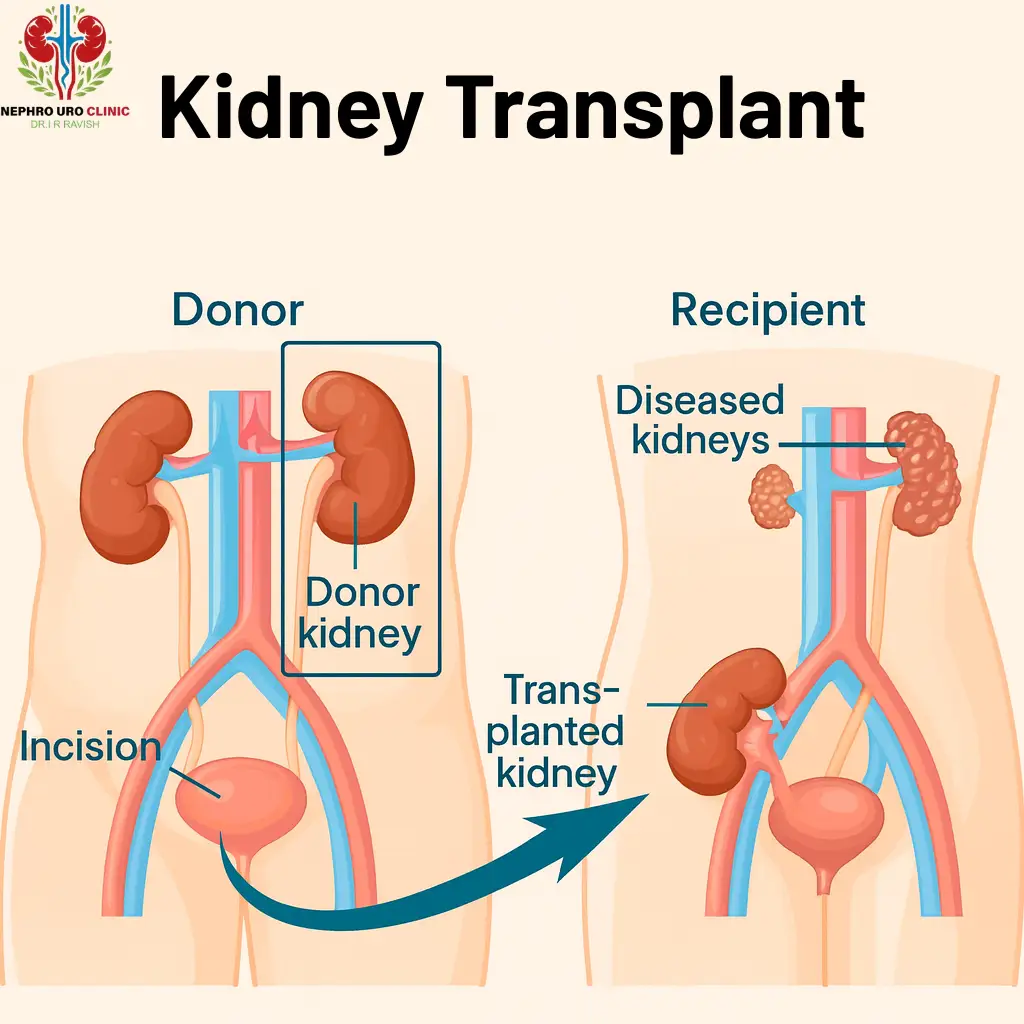
How Successful are Kidney Transplants
It helps to know that kidney transplant outcomes are usually reported in two separate ways: patient survival, meaning how many patients are alive at a given point, and graft survival, meaning how many transplanted kidneys are still working at that point. These are not the same thing, and a page that only says “success rate” without specifying which one can be misleading.
A recent review of Indian transplant data, published in the Indian Journal of Nephrology, gives a useful general picture:
- At one year, patient survival is typically around 95 percent, and graft survival is typically around 90 to 95 percent.
- At five years, patient survival is typically around 85 to 90 percent, and graft survival is typically around 75 to 80 percent.
- At ten years, patient survival is typically around 70 to 75 percent, and graft survival is typically around 60 to 65 percent.
These figures vary by donor type, the patient’s own health, the transplant center, and how closely medicines are followed after surgery. It is worth asking your own transplant team what outcomes they have seen with cases similar to yours, since these are national averages, not a specific claim about any one hospital.
What Affects the Final Cost
The kidney transplant cost in Bengaluru is rarely a flat number. A few things tend to move it up or down:
- Whether you have a living donor. A medically suitable living donor can allow the transplant to be planned without waiting for deceased donor allocation, though donor evaluation, compatibility testing, and regulatory approval are still required either way.
- Type of hospital. Private hospitals generally cost more than government hospitals, though government hospitals can involve a longer wait and, at some centers, lower cost care.
- Which hospital and area of the city. Even within Bengaluru, premium hospitals charge more than mid range ones.
- Surgical approach. Laparoscopic donor surgery usually costs a bit more than open surgery, but tends to help the donor recover faster.
- Your surgeon and transplant team. Many patients choose a surgeon and hospital with a strong transplant track record, which can be a reasonable priority for a procedure like this.
- Pre transplant tests. The extent of testing needed depends on your health and any other conditions you have.
- Recovery and any complications. A longer ICU stay or an episode of rejection can add to the bill.
- Medicines going forward. Anti rejection medicines are lifelong, and cost more in the first year than in later years.
- Travel and stay. If you are coming from outside Bengaluru, factor in accommodation and daily expenses during your treatment and recovery period.
Because each case is different, the most reliable way to plan is to ask your chosen hospital for a written, itemised estimate rather than relying only on general figures like the ones in this guide.
What Patients Should Know Before Starting
A few practical points can make the journey smoother if you are considering a kidney transplant in Bengaluru.
Look for a donor early. A medically suitable living donor, often a close family member, can allow surgery to be planned without waiting on the deceased donor list. In India, near relative donation is processed through your hospital’s Authorization Committee. If the donor is not a close relative, the case goes through a more detailed review by the same committee, which takes more time.
Understand the legal process. India has strict laws against organ trafficking, and every transplant needs Authorization Committee clearance with complete documentation. If you are a foreign national considering treatment in India, donor eligibility rules and documentation requirements are specific and can involve embassy or consular verification. Rather than relying on a general summary, confirm your exact situation directly with an authorized transplant centre’s coordinator before making travel or treatment plans, since this is an area where getting current, case-specific guidance matters.
Choose a hospital with real transplant experience. Look for strong ICU support, a dedicated transplant team, and a track record you can verify. Asking about the team’s experience directly, checking credentials, and reading patient reviews are all reasonable steps before choosing the best kidney transplant doctor in Bengaluru for your case.
Plan your finances ahead of time. Costs vary widely, so compare hospital packages carefully and check what your insurance actually covers. Keep some contingency funds aside for medicines or unexpected complications.
Recovery care matters as much as the surgery. Long term success depends heavily on taking anti rejection medicines exactly as prescribed and keeping up with follow up visits. Patients travelling from outside Bengaluru should ask their transplant team how long they will need to stay nearby after discharge, since this varies by case.
You are not alone in this. Bengaluru has patient support groups and hospital counselors who understand what families are going through. Many patients gradually return to their normal activities over the weeks and months that follow, though the right timing to return to work depends on your recovery, your job, and your transplant team’s advice.
Expect a few bumps along the way. Minor delays or complications can happen. Give yourself some flexibility in both time and budget. It also helps to know the general warning signs that need prompt medical attention, such as fever, reduced urine output, swelling, unexplained weight gain, or any noticeable change in how you are feeling. These can point to a few different things, including infection, rejection, or another complication, so they are worth calling your transplant team about right away rather than waiting to see if they pass.
In Summary
The total cost of a kidney transplant in Bengaluru can vary considerably from one hospital and one patient to another, so it is best treated as a range rather than a fixed number, and confirmed directly with your chosen hospital before you commit. Even with this variation, patients in Bengaluru get access to skilled surgeons, well equipped hospitals, and outcomes that compare well with major transplant centers elsewhere in the country.
For suitable patients, a transplant can offer real quality of life and long term health benefits, and may reduce the long term financial and treatment burden of staying on dialysis, though outcomes and costs vary between individuals and it also comes with lifelong medicines and follow up care of its own. Working with an experienced urologist, and being upfront with your hospital about costs from the very first consultation, tends to make the whole process far less stressful.
If you are exploring your options and want a clear, honest estimate based on your own situation, speaking with a urologist experienced in kidney transplant in Bengaluru is the best next step. Dr. I. R. Ravish and the team at Nephro Uro Clinic can help you understand where you stand and what to expect.