Medically reviewed by Dr. I. R. Ravish, MBBS, MS, MCh (Urology), Nephro Uro Clinic, Bengaluru | Last Reviewed: October 2026
Kidney stones are a common urinary condition that can cause discomfort, pain, and difficulty passing urine. They develop when minerals and salts in the urine form hard deposits inside the kidneys. The size, location, and type of stone can vary from person to person, influencing the symptoms and treatment approach.
If you are looking for Kidney Stone Doctor in Bengaluru, understanding the available treatment options can help you make informed decisions about your kidney health. Depending on the stone’s size and location, treatment may include medication, lifestyle changes, or medical procedures to remove or break down the stones. Early evaluation by a qualified urologist can help identify the condition and determine an appropriate treatment plan.
What Are Kidney Stones?
Kidney stones are hard deposits made from minerals and salts that build up inside the kidney. Urine normally carries these substances out of the body in dissolved form. When there is too little water, or too much of a certain mineral, they can clump together and crystallise. Over weeks or months, a crystal becomes a stone.
Stones vary a lot. Some are the size of a grain of sand. Others grow large enough to fill a part of the kidney. A stone sitting quietly in the kidney may cause no trouble at all. The pain usually starts when it moves into the ureter, the narrow tube that carries urine down to the bladder, and blocks the flow.
Why Do Stones Form?
There is rarely one single reason. Common contributors include:
- Not drinking enough water, especially in Bengaluru’s warmer months or for people who work outdoors
- Too much salt in the diet
- A diet heavy in animal protein
- Family history of stones
- Certain medical conditions, such as gout, urinary infections, or metabolic disorders
- Some medicines and supplements
- Long gaps without passing urine
Sometimes, even after tests, the cause stays unclear. That is common and does not mean anything has been missed.
Symptoms You Should Not Ignore
Kidney stone pain has a reputation, and it is earned. Many patients describe it as one of the most intense pains they have felt. But not every stone announces itself this loudly. Watch for:
- Severe pain in the back or side, below the ribs, that may travel toward the lower abdomen or groin
- Pain that comes in waves and changes position
- Burning or pain while passing urine
- Blood in the urine, which may look pink, red, or brown
- Frequent or urgent need to pass urine
- Nausea or vomiting
- Cloudy or foul-smelling urine
When It Is an Emergency
Most stones can be managed with a planned consultation. A few situations cannot wait. Go to the nearest emergency department right away if you have:
- Fever or chills along with back or flank pain
- No urine at all, or very little, for many hours
- Vomiting so severe that you cannot keep medicines down
- Pain that is unbearable and not easing
These can point to an infected or blocked kidney, which needs prompt hospital treatment. Please do not wait for a clinic appointment in these cases.
How Kidney Stones Are Diagnosed
A good treatment plan starts with a good picture of what is going on. That usually means a few steps:
A conversation first. Your doctor will ask about your pain, past stones, diet, fluid intake, medicines, and family history. These answers matter more than most people expect.
Imaging. An ultrasound is often the first test. It can show the stone, and whether the kidney is swollen because urine is backing up. An X-ray of the abdomen or a CT scan may be added to measure the stone’s exact size, position and density. A low-dose CT is commonly used because it gives the clearest map. Where detailed imaging such as a CT urogram is needed, it is arranged through external imaging centres.
Urine and blood tests. These check for infection, blood, kidney function, and levels of minerals such as calcium and uric acid. If you have had more than one stone, a deeper metabolic evaluation may be advised.
Stone analysis. If a stone is passed or removed, testing its composition helps shape the prevention plan.
None of this is meant to be done in a rush. Good evaluation is what keeps you from having an unnecessary procedure, or from skipping a necessary one.
Treatment Options for Kidney Stones
There is no single “right” treatment for every stone. The choice depends on the stone’s size, hardness and location, whether there is infection or blockage, your overall health, and sometimes your personal preference after the options are explained. Here is how the main routes work.
1. Observation and Medication
For small stones without infection or serious blockage, your doctor may suggest waiting, along with fluids, pain relief and medicines that help the stone pass. This needs follow-up scans and clear instructions on warning signs. It is a plan, not neglect.
2. Ureteroscopy with Laser Lithotripsy
A thin, flexible scope is passed through the natural urinary passage to reach the stone. A laser then breaks it into tiny fragments or dust, which are removed or washed out. There is no external cut. It is commonly used for stones in the ureter and many kidney stones. When it is used for stones inside the kidney, it is often called RIRS (retrograde intrarenal surgery). You can read more on our page about ureteroscopy and laser treatment.
3. Percutaneous Nephrolithotomy (PCNL)
For larger or more complex kidney stones, a small access tunnel is made through the skin of the back. A scope goes in through it, and the stone is broken up and removed. It is a keyhole approach rather than open surgery, and it is chosen when a stone is too large or too hard for other methods.
If a stone is blocking the kidney and there is infection, the first step is often to relieve the blockage and treat the infection. The stone itself is dealt with once things are safe.
Every procedure carries some risk, such as bleeding, infection, or the need for a repeat procedure. Your doctor should explain these clearly before you decide. Results differ from person to person, and no responsible doctor can promise a specific outcome.
Kidney Stone Doctor in Bengaluru
Meet Dr. I. R. Ravish
Dr. I. R. Ravish is a urologist practising in Bengaluru with close to three decades of experience in the field. His qualifications include:
- MBBS
- MS in General Surgery
- MCh in Urology
- Fellowship in Paediatric Urology (KLEU, in association with training in Minnesota, USA)
His training covers both adult and paediatric urology, so he sees kidney, ureter and bladder stones in adults and in children. Over the years he has managed everyday stone problems as well as repeat cases where earlier treatment had not fully settled things. Patients are welcome to ask for his credential documents at the clinic.
His approach rests on three habits:
- Evaluate first. A stone is looked at in context: imaging, urine and blood tests, and your history. The goal is to understand the stone before choosing how to deal with it.
- Match the treatment to the stone. A small stone low in the ureter and a large stone deep in the kidney are very different problems. A fixed protocol for everyone does not make sense.
- Plan for prevention. Taking a stone out without asking why it formed often means meeting the same problem again in a year or two. Time is spent on diet, hydration and follow-up so you have a realistic chance of staying stone-free.
What to Expect at Your First Consultation
Many people arrive nervous, so here is how the visit usually goes.
- Bring what you have. Old scans, ultrasound reports, blood and urine tests, and a list of medicines you take. A phone photo of a report is better than nothing.
- Tell your story. When the pain started, what makes it better or worse, what you eat and drink on a normal day, and whether anyone in the family has had stones.
- Examination and review. Your reports are reviewed and you may be advised on further tests.
- A plain explanation. You should leave knowing the stone’s size and location, your options, and the pros and cons of each. Ask about risks and recovery time too.
Recovery: What Most People Can Expect
Minimally invasive stone procedures are usually completed in one to two hours, depending on the stone. Many patients go home within a day, and light activity often resumes within a few days. Some soreness, mild blood in the urine, or a burning feeling while passing urine is common for a short while, especially if a stent has been placed.
Your own timeline will depend on your stone, your general health and the procedure chosen, so follow the instructions given to you rather than a general guide. Contact your doctor if you develop fever, heavy bleeding, worsening pain or trouble passing urine after a procedure. For more detail, see our page on laser lithotripsy recovery time.
How to Lower Your Chance of Another Stone
Stones can return, so prevention deserves real attention. Your doctor will tailor advice to your tests, but these basics help most people:
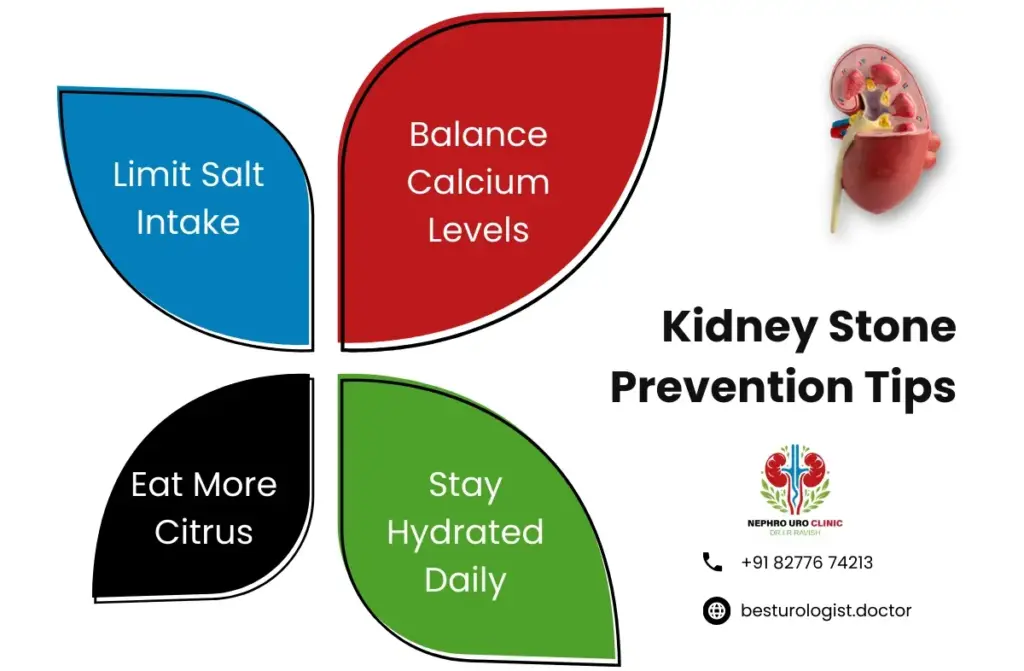
- Drink enough water through the day. A common target is enough fluid to pass roughly two to two and a half litres of urine daily. If you have heart or kidney conditions, check with your doctor first.
- Go easy on salt. Pickles, papads, packaged snacks and instant foods add up quickly.
- Do not cut calcium out. Normal dietary calcium actually helps, because it binds oxalate in the gut. Be cautious with calcium supplements unless advised.
- Moderate animal protein. Large portions of meat, fish and eggs can raise stone-forming chemicals in urine.
- Be mindful with high-oxalate foods such as spinach, beetroot, nuts and strong tea, particularly if your stone analysis points to oxalate.
- Do not hold urine for long stretches.
- Follow up. Repeat ultrasounds or urine tests help catch a new stone early, when it is easiest to handle.
Frequently Asked Questions
How do I know if my kidney stone needs surgery? It depends mainly on size, location and symptoms. Small stones, often those under about 5 mm, may pass with fluids and medication. Stones of about 6 to 7 mm or larger, or any stone causing blockage, infection or severe pain, may need a procedure. Imaging shows which group your stone falls in.
Is kidney stone surgery painful? Procedures are done under anaesthesia, so you will not feel pain during the surgery. Some soreness afterwards is normal and is managed with medicines.
Can kidney stones come back after treatment? Yes, they can, especially without follow-up and lifestyle changes. This is why diet, hydration and testing are part of the plan.
How soon can I return to work? After minimally invasive procedures, many people return to near-normal activity within a few days to a week. This varies with the procedure and with how you recover.
Does Dr. Ravish treat children with kidney stones? Yes. His fellowship training in paediatric urology means he sees children as well as adults.
In Conclusion
A kidney stone is painful and frightening, but it is also one of the more treatable problems in urology. The path usually follows a simple order: understand the stone, choose the treatment that fits it, recover well, and take steps so it does not come back.
If you are dealing with kidney stone pain, or you have a report that mentions a stone and you are unsure what comes next, a consultation can help you understand your options before you decide anything. You can call the clinic on +91 88612 21822 or visit the contact page to request an appointment. If you have fever with flank pain, or cannot pass urine, please go to the nearest emergency department straight away.