Medically reviewed by Dr. I. R. Ravish, Urologist | Last updated: August 1, 2026
This article has been reviewed for medical accuracy and reflects current, evidence-based practice. It is written for general understanding and does not replace a consultation with your doctor.
Prostate problems tend to get ignored until they become hard to ignore. Getting up three times a night to urinate, or noticing a weaker stream than you used to have, is easy to write off as just getting older. Sometimes that is all it is. But it can also be your body asking for a closer look from a prostate doctor in Bengaluru.
This guide walks you through what the prostate actually does, what commonly goes wrong with it, and what care in Bengaluru looks like if you need it.
What the Prostate Does and Why It Matters
The prostate is a small gland, roughly the size of a walnut, sitting just below the bladder in men. Its main job is making the fluid that carries and protects sperm. Most men never think about it until it starts causing trouble, usually with urination.
As men age, the prostate tends to grow. This growth is often harmless, but it can press on the urethra and make urinating uncomfortable or inconvenient. In some cases, cells in the prostate change in ways that are more serious and need closer monitoring.
The Three Conditions Most Men Run Into
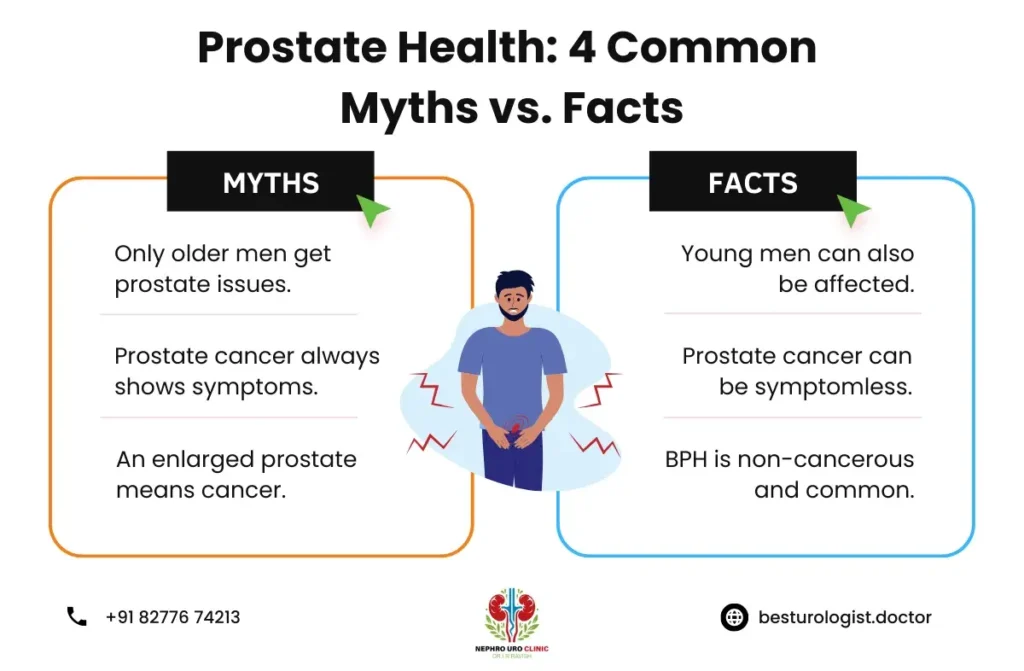
- Benign Prostatic Hyperplasia (BPH). This is a non-cancerous enlargement of the prostate. It is extremely common after age 50 and mainly causes urinary symptoms rather than being dangerous on its own.
- Prostatitis. This is inflammation of the prostate, often from infection. It can affect younger and middle-aged men too, and it usually comes with pain rather than just urinary changes.
- Prostate cancer. This is a more serious condition where cells in the prostate grow abnormally. It is one of the more common cancers in men, but when caught early, it is also one of the more manageable ones.
Signs Worth Paying Attention To
Not every symptom below means something serious. But if you notice a few of these together, or if they stick around for more than a couple of weeks, it is worth getting checked.
- Needing to urinate often, especially at night
- Trouble starting or stopping your stream
- A weak or interrupted urine flow
- Feeling like your bladder never fully empties
- Burning or pain while urinating
- Blood in urine or semen
- Pain in the pelvis, lower back, or groin
- Pain during ejaculation
- Discomfort from sitting for long periods
- Changes in erectile function
What Usually Causes Prostate Problems
- Age. The prostate naturally grows over time, and BPH becomes increasingly common past 50.
- Hormones. Shifts in testosterone and related hormones can influence how the prostate grows.
- Infection. Bacterial or non-bacterial infections can inflame the prostate, which is what causes prostatitis.
- Everyday habits. A sedentary lifestyle, a poor diet, obesity, smoking, and heavy alcohol use are all linked to a higher risk of prostate issues.
- Family history. If prostate problems run in your family, your own risk goes up, which is a good reason to start screening a little earlier.
How Prostate Problems Are Diagnosed
Diagnosis usually starts with a conversation about your symptoms and family history, followed by a physical exam. From there, your doctor may use:
- A digital rectal exam (DRE) to check the size and feel of the prostate
- A PSA (prostate-specific antigen) blood test to screen for abnormalities
- A urine test to rule out infection
- An ultrasound to get a clearer picture of the prostate
- Uroflowmetry, a simple test that measures how fast you urinate
Most of these are quick, and none require a hospital stay.
Treatment Options, From Simplest to Most Involved
The right treatment depends entirely on what is causing your symptoms and how severe they are. Broadly, options include:
- Medication. For BPH, drugs like alpha-blockers can relax the muscles around the prostate, while 5-alpha-reductase inhibitors can shrink it over time.
- Minimally invasive procedures. Laser-based treatments, such as Holmium Laser Enucleation of the Prostate (HoLEP), remove excess prostate tissue with less bleeding and a faster recovery than traditional surgery.
- Surgery. Transurethral Resection of the Prostate (TURP) or, in cancer cases, a radical prostatectomy may be needed to remove tissue or the gland itself.
- Radiation therapy. For localized prostate cancer, radiation can target cancer cells while sparing as much healthy tissue as possible.
Most men start with the least invasive option that makes sense for their case, and only move further if that is not enough.
About Dr. I. R. Ravish
Dr. I. R. Ravish is a urologist and laparoscopic surgeon based in Bengaluru, with over 28 years of clinical experience in urology.
- Qualifications: MBBS, MS (General Surgery), MCh (Urology), Fellowship in Pediatric Urology (KLEU, India, with further training at a US institution)
- Current practice: Medical Director at Vikram Hospital, Bengaluru, and consulting urologist at Aster RV Hospital, Aster CMI Hospital, Mallige Hospital, and Sagar Hospital
- Focus areas: BPH, prostate cancer, prostatitis, male infertility, kidney stones, and transplant surgery, with particular expertise in HoLEP, a minimally invasive laser procedure for prostate enlargement
- Recognition: Young Surgeon’s Award (2015) and International Healthcare Award (2017)
His approach centers on a full evaluation before treatment, meaning imaging, symptom review, and functional testing are used together, so that the treatment plan actually matches the patient’s specific condition rather than a one-size-fits-all protocol.
When to See a Prostate Specialist
If you are having ongoing urinary symptoms, pelvic pain, or a family history of prostate problems, it is worth booking a consultation rather than waiting to see if things improve on their own. Early evaluation tends to mean simpler treatment and a faster return to normal.
A Final Thought
Prostate issues are common, and for most men, they are very treatable once identified. The hardest part is usually just making the first appointment. After that, you are working with a clear plan instead of guesswork.
Read also Best Male Fertility Doctor in Bengaluru.