If you are reading this, there is a good chance you are in pain right now, or trying to help someone who is. Kidney stone pain can hit hard and fast. It can feel like something is twisting inside your back or lower belly. Sitting still feels impossible, and finding a comfortable position can feel out of reach.
One of the most frustrating aspects of kidney stones is the uncertainty that comes with them. Is the pain normal? Will the stone pass on its own? When should you seek emergency care? And perhaps most importantly, how to get rid of kidney stone pain right now?
The good news is that most kidney stones can be managed effectively with the right treatment and guidance. Understanding what causes the pain, how long it may last, and what options are available can help you navigate the experience with far more confidence.
This guide explains what kidney stone pain feels like, what may help relieve symptoms, the treatment options available, and how to reduce the risk of future stones.
What Helps Kidney Stone Pain Right Now
When kidney stone pain strikes, finding relief becomes the immediate priority. While treatment depends on the size and location of the stone, several general measures may help you stay more comfortable while awaiting treatment or the natural passage of the stone.
Take pain relief as directed by your doctor. Anti-inflammatory pain medication is often preferred as a first-line option for kidney stone pain because it can help reduce inflammation in the ureter rather than only masking the discomfort. However, it needs to be used cautiously or avoided in people with significant kidney impairment, dehydration, active stomach ulcers or GI bleeding, certain heart conditions, or those on blood-thinning medication. The right choice and dose depends on your full medical history, so always follow your doctor’s specific guidance rather than self-dosing.
Stay hydrated, without forcing large amounts during peak pain. Adequate water intake supports normal urine flow and helps prevent dehydration, but drinking heavily does not reliably speed up passage during an acute attack, especially if the stone is causing a significant blockage. In fact, overloading the kidneys with fluid while a stone is actively obstructing urine flow can increase pressure behind the stone and worsen the pain. Ask your doctor what daily fluid target is right for you.
Apply a heating pad to the back or side. Heat can help relax the muscles around the ureter. It will not remove the stone, but it may ease the cramping and spasm-like pain while you wait for it to pass.
Keep moving gently, rather than staying completely still. Light walking can sometimes help a stone shift position and move toward the bladder. Bedrest alone does not speed up the process.
Ask your doctor about medication that relaxes the ureter. Certain prescription medications work by relaxing the smooth muscle inside the ureter, which can make it easier for select stones, particularly those lower in the ureter, to pass. This is not appropriate or necessary for every stone. Your doctor can advise whether it fits your situation after an evaluation.
While these measures may provide meaningful relief, persistent or severe pain should always be evaluated by a healthcare professional.
When to Go to the Emergency Room Immediately
Although many kidney stones pass without major complications, some situations require urgent medical attention. Go to the emergency room right away if you experience:
- Pain so severe that you are vomiting and cannot keep fluids down
- Fever or chills
- Severe pain that does not improve with medication
- Difficulty passing urine, or a complete inability to urinate
- Persistent heavy bleeding in the urine, or blood clots, rather than a faint pink tinge
- Dizziness or other signs of significant blood loss
- Pain on the side of your only kidney, if you have just one, or any history of a kidney transplant, since a transplanted kidney can develop a serious blockage without the typical warning pain
- Signs of dehydration
Fever together with kidney stone pain is a medical emergency. It can mean the stone has caused an infection inside a blocked kidney, a condition that can become serious within hours without prompt antibiotics and drainage. Do not wait it out at home if these signs appear.
What Does Kidney Stone Pain Actually Feel Like?
Understanding your own pain can help you describe it clearly to a doctor, which speeds up diagnosis and treatment.
Kidney stone pain, medically known as renal colic, usually starts suddenly. It often begins in the flank, the area below the ribs and above the hip on one side of the back, and can spread to the lower belly, groin, and inner thigh as the stone moves.
The pain typically comes in waves: building suddenly, easing slightly, then returning. Unlike a muscle strain or back injury, no position fully relieves it, which is why restlessness is such a common symptom.
As the stone moves closer to the bladder, the pain and pressure often shift downward, sometimes with an urgent need to urinate even when little comes out.
Other common symptoms include:
- Nausea and vomiting during intense episodes
- Pink, red, or brown-tinged urine
- Burning or discomfort during urination
- Cloudy or foul-smelling urine, especially if infection is present
- Frequent urge to urinate with only small amounts passing
The intensity of the pain does not always reflect the size of the stone. A small stone lodged at a narrow point in the ureter can sometimes cause more pain than a larger stone that is moving freely.
How Kidney Stones are Diagnosed
If your doctor suspects a kidney stone, a few tests help confirm it and guide treatment. A urinalysis checks for blood, infection, and crystals in the urine. Blood tests can assess kidney function and look for underlying causes such as high calcium or uric acid levels. Imaging is usually needed to see the stone itself: an ultrasound is often used first, especially to check for blockage, while a non-contrast CT scan is the most detailed way to confirm a stone’s size, location, and density. Your doctor will decide which combination of tests is right for your situation.
What Causes Kidney Stones?
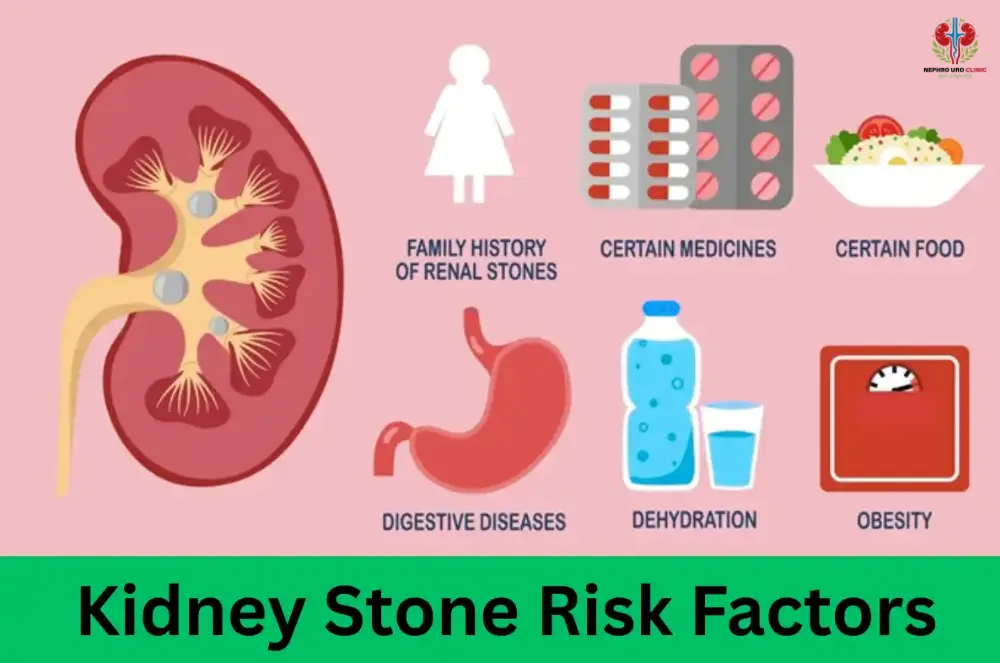
Kidney stones form when certain minerals and salts in the urine become concentrated and crystallize, joining together over time to form stones.
Several factors can increase the risk:
- Not drinking enough water
- High sodium intake
- Diets rich in oxalate-heavy foods such as spinach, beets, nuts, and chocolate
- High intake of animal protein
- Obesity
- Family history of kidney stones
- Certain medical conditions, including some metabolic and bowel conditions
- Recurrent urinary tract infections
- Some medications, including certain diuretics or unsupervised calcium supplementation
Kidney stones rarely result from a single cause. In most cases, lifestyle, genetics, and underlying health conditions work together to increase risk, and understanding why a stone formed is an important step toward preventing another one.
Types of Kidney Stones
Not all kidney stones are the same, and identifying the type can help guide both treatment and prevention.
| Type of Stone | Common Cause |
|---|---|
| Calcium Oxalate / Calcium Phosphate Stones | Excess calcium or oxalate in urine; the most common type seen in clinical practice |
| Uric Acid Stones | High uric acid levels and acidic urine, often linked to high red meat intake or gout |
| Struvite Stones | Chronic infections caused by specific urea-splitting bacteria, which can lead to fast-growing stones |
| Cystine Stones | Rare inherited disorder |
Understanding the stone type can provide valuable insight into why the stone formed and how future episodes may be reduced, which is why your doctor may recommend testing the stone’s composition after it passes or is removed.
How Long Does It Take to Pass a Kidney Stone?
One of the most common questions patients ask is how long a kidney stone will take to pass. The answer depends largely on the stone’s size and location, as well as overall health.
| Stone Size | Typical Outcome |
|---|---|
| Less than 4 mm | Often passes naturally, though this can take anywhere from a few days to 4-6 weeks |
| 4-6 mm | May pass with time but often benefits from medical support |
| Larger than 6-7 mm | More likely to require intervention |
The location of a stone is often just as important as its size. Some small stones cause significant discomfort, while others pass with relatively mild symptoms. Staying in close communication with your healthcare provider throughout this waiting period helps ensure the safest, most effective approach.
Medical Treatments When the Stone Will Not Pass
If a stone is too large, causing a blockage, or leading to repeated infections, your urologist will discuss the options with you. Hearing that a procedure may be needed can feel intimidating, but modern treatments are highly effective and designed to relieve pain, remove the obstruction, and protect kidney function.
Medications can help relax the urinary tract and improve the chances of a stone passing on its own.
Shock Wave Lithotripsy (SWL) uses sound waves from outside the body to break selected stones into smaller fragments that can pass more easily. It is not suitable for every stone; suitability depends on the stone’s size, location, density, and the patient’s anatomy. It is usually done as a day procedure with no cuts or stitches.
Ureteroscopy with laser fragmentation involves passing a thin scope through the urinary tract to reach the stone directly, then using a laser to break it into tiny pieces. This is highly effective for stones in the ureter and lower kidney, and is the approach Dr. I. R. Ravish and the team at Nephro Uro Clinic commonly use with advanced laser technology.
Percutaneous Nephrolithotomy (PCNL) is reserved for very large (typically over 2 cm) or complex stones inside the kidney. A surgeon removes the stone through a small incision in the back. This is a more involved procedure performed under general anaesthesia, but is very effective for stones that cannot be managed any other way.
Your doctor will recommend the most appropriate treatment based on the stone’s size, location, and type, along with your overall health.
Home Remedies that have Some Evidence
Many people look for ways to manage symptoms at home, particularly while waiting for a stone to pass. Home remedies have limitations and should never replace professional medical care, but a few approaches may offer supportive benefit:
- Citrus fruits and citrate. The citric acid found in lemons and other citrus fruits may help slow the growth of certain calcium oxalate stones. Ask your doctor whether adding citrus to your diet or water is appropriate for your stone type.
- Staying physically active, such as regular gentle walking, may help a stone move along the urinary tract. Bedrest alone does not help stones pass faster.
- Following your doctor’s dietary guidance, including sodium and calcium intake tailored to your stone type.
No home remedy can reliably dissolve every type of kidney stone, and none of these should replace medical evaluation if pain is severe or emergency warning signs are present.
How to Prevent Kidney Stones from Coming Back
For many people, the memory of kidney stone pain is enough to make prevention a lifelong priority. The good news is that a few consistent habits can meaningfully reduce the risk of a repeat episode.
- Drink enough water throughout the day. Pale yellow urine is generally a good sign of adequate hydration; dark yellow suggests you need more fluids.
- Limit excess sodium intake. High sodium causes the kidneys to release more calcium into the urine, which can combine with oxalate to form stones.
- Maintain a balanced calcium intake from food rather than supplements, unless your doctor advises otherwise. Dietary calcium from dairy, leafy greens, and fortified foods actually binds oxalate in the gut before it reaches the kidneys. If you take calcium supplements for another health condition such as osteoporosis, do not stop them without talking to your doctor; taking them with meals allows the calcium to bind oxalate in the gut the same way dietary calcium does, which can help offset the stone-risk concern.
- Moderate animal protein intake, as it can raise uric acid levels and lower citrate, both of which favor stone formation.
- Limit high-oxalate foods like spinach, rhubarb, beets, nuts, chocolate, tea, and sweet potatoes if you have had calcium oxalate stones, ideally pairing them with a calcium-containing food rather than avoiding them entirely.
- Limit sugary drinks, which have been linked to higher stone risk in several studies.
- Follow dietary advice specific to your stone type, since prevention strategies differ by stone composition.
- Attend follow-up appointments so your doctor can test the stone’s composition and run blood or urine tests to identify your specific risk factors.
If you have had one kidney stone before, your risk of another is real, which is why a personalized prevention plan based on your test results is the most effective long-term approach.
A Note from Dr. I. R. Ravish
Kidney stone pain is one of the most intense forms of pain a person can experience, and it is something we see regularly in clinical practice. One of the most important things I tell patients is that this pain should never be ignored when it becomes severe, or when it is accompanied by fever, vomiting, or difficulty passing urine. Early evaluation not only helps relieve discomfort but can also prevent complications.
Just as importantly, understanding why a stone formed helps us create a personalized plan to reduce the chances of it happening again. Staying well hydrated, following dietary recommendations, and seeking timely medical care are often the most effective tools for protecting long-term kidney health.
If you are based in Bengaluru and are dealing with kidney stones or recurrent episodes, you are welcome to visit us at Nephro Uro Clinic, Jayanagar, where our team uses advanced diagnostic imaging and laser-based procedures for accurate, minimally invasive care.
Conclusion
Kidney stone pain can be one of the most uncomfortable and unexpected health experiences a person faces. The intensity of the pain, combined with the uncertainty of when relief will come, can make the situation feel overwhelming.
The reassuring reality is that effective treatments are available, and many kidney stones can be managed successfully with timely medical care. Understanding the symptoms, recognizing warning signs, and knowing when to seek help can make the journey far less stressful.
If you have experienced a kidney stone before, you already know how important prevention can be. Staying well hydrated, following medical advice, and making appropriate lifestyle changes can significantly reduce the risk of future stones.
Relief is possible, recovery is achievable, and for many people, a kidney stone becomes not just a medical event but a reminder of the importance of long-term kidney health.