If you have been told you have a kidney stone, your first question is probably simple. Who should I see, and can I trust them to treat this the right way?
If you are looking for an experienced kidney stone doctor in Bengaluru, Dr. I. R. Ravish provides comprehensive evaluation and treatment for kidney stones, from small stones that may pass naturally to large, complex stones that require advanced surgical care. With close to three decades of medical experience, he offers personalized treatment based on each patient’s condition. Consultations, diagnostic workup, and follow-up care take place at Nephro Uro Clinic, while major surgical procedures are performed at his affiliated hospitals in Bengaluru, which have fully equipped operation theatre facilities.
This page will help you understand who he is, how he approaches kidney stone care, and what to expect if you book a consultation.
When to go to the emergency department instead of booking a clinic visit Most kidney stones can be managed through a routine consultation. But some symptoms need urgent hospital care, not a scheduled appointment. Go to the nearest emergency department right away if you have:
- Fever or chills along with back or flank pain
- Inability to pass urine at all
- Vomiting so severe that you cannot keep down pain medication
These can signal a blocked or infected kidney, which needs prompt treatment.
Who Is Dr. I. R. Ravish
Dr. Ravish holds an MBBS, an MS in General Surgery, and an MCh in Urology. He also completed a Fellowship in Paediatric Urology (KLEU, in association with training in Minnesota, USA). This training means he treats both adults and children with kidney stones and other urological conditions. Patients can request his full credential documents at the clinic.
Over the years, he has managed a wide range of stone cases, including stones in the kidney, the ureter, and the bladder. He has seen straightforward cases and difficult, repeat cases where earlier treatment elsewhere did not fully solve the problem.
How He Approaches a Kidney Stone Case
A stone is never treated in isolation. Dr. Ravish looks at the full picture before deciding on a plan.
Full evaluation first. This includes imaging to see the stone’s size and location, and often blood or urine tests to understand what caused it. Some patients form stones because of diet, some because of a metabolic issue, and some for reasons that are not obvious without testing.
Treatment matched to the stone, not a fixed protocol. Stone size, hardness, and position all affect which option makes sense. A small stone low in the ureter is handled very differently from a large stone deep in the kidney.
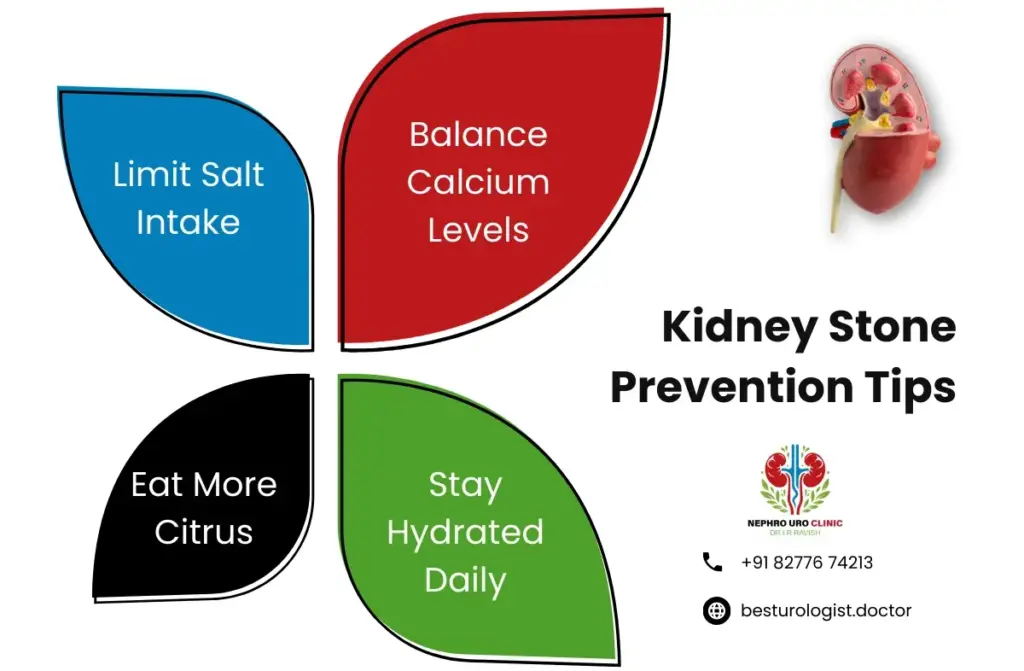
Prevention is part of the plan, not an afterthought. Removing a stone without addressing why it formed often means the same problem returns in a year or two. Dr. Ravish spends time on diet, hydration, and follow up testing so patients have a real chance at staying stone free.
This evaluation-first approach helps ensure that treatment is tailored to each patient’s individual condition and needs.
Treatment Options He Offers
Depending on the case, Dr. Ravish may recommend:
- Watchful waiting with medication, for small stones likely to pass naturally
- Ureteroscopy with laser lithotripsy, a scope based procedure that breaks up and removes stones with no external cut
- Percutaneous Nephrolithotomy (PCNL), used for larger or more complex kidney stones through a small access point
Laser and other major stone surgeries are performed at Dr. Ravish’s affiliated hospitals in Bengaluru, which have the operation theatre infrastructure these procedures need. Your consultation, evaluation, and follow up visits happen at Nephro Uro Clinic. Where detailed imaging such as a CT urogram is required, this is arranged through trusted external imaging centres.
For a full breakdown of how each of these procedures works, recovery time, and who is a good candidate, see our detailed kidney stone treatment guide.
What to Expect During Recovery
Most minimally invasive kidney stone procedures are completed within one to two hours, depending on the size, location, and complexity of the stone. Many patients go home within a day, and return to light activity within a few days depending on the procedure and how the individual recovers. Your specific timeline will depend on your stone, your health, and the procedure chosen, so ask your doctor for guidance specific to your case.
Why Patients Choose Dr. Ravish
- Nearly three decades of hands on experience in urology
- Training that covers both general urology and paediatric urology
- A diagnosis first approach rather than jumping straight to surgery
- Equal attention given to preventing future stones, not just removing the current one
Book a Consultation
If you are dealing with kidney stone pain, or you have been told you have a stone and are not sure what happens next, a consultation with Dr. Ravish can help you understand your options clearly before you decide anything.
Because Dr. Ravish relies on thorough, test based evaluation before recommending treatment, the clinical team coordinates your imaging and lab work in advance where possible. This way, your time with the doctor stays focused on discussing your results and deciding on the right treatment path, rather than on paperwork.